


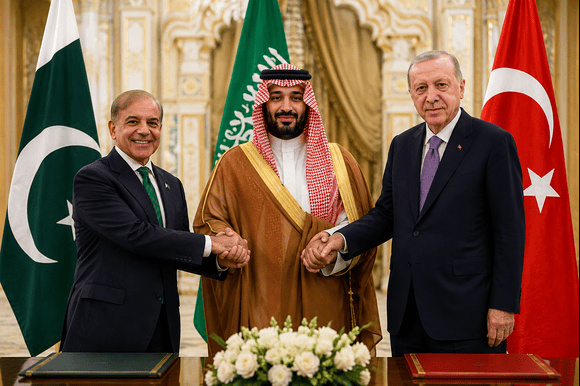
Pakistan, Türkiye and Saudi Arabia have entered a major new phase of strategic cooperation after signing a joint defence agreement designed to strengthen collective security and deter potential threats against any of the three countries.
The agreement, signed in Makkah, brings together three influential Muslim-majority states with significant military, economic and geopolitical weight. It comes at a particularly sensitive time, as conflicts and tensions across the Middle East continue to create risks for regional stability, energy supplies and international shipping.
Under the agreement, an armed attack against any one of the three countries will be treated as an attack against all three. The arrangement is intended to strengthen collective deterrence while expanding cooperation in defence and security.
The governments of Pakistan, Türkiye and Saudi Arabia have stressed that the agreement is defensive rather than offensive and is not aimed at any particular country.
Pakistan’s Foreign Ministry has said the pact is designed to protect the sovereignty and territorial integrity of the three nations and contribute to regional peace and stability.
The agreement represents a significant development in the longstanding defence relationships between the three countries. Pakistan already has close military ties with Saudi Arabia, while Türkiye and Pakistan have developed extensive defence cooperation and increasingly strong political relations.
The new trilateral framework brings these relationships together under a formal collective-security arrangement.
Agreement Strengthens Collective Defence
The agreement’s most important provision is its collective-defence clause.
The three countries have agreed that an armed attack against one member will be regarded as an attack against all members.
The commitment creates a stronger deterrence mechanism and could require the three governments to coordinate their response if one of them comes under military attack.
However, the agreement does not publicly establish that every attack would automatically result in the same military response.
The precise nature of assistance would depend on the circumstances of a crisis and consultations between the three governments.
Pakistan has described the agreement as being consistent with the right of individual and collective self-defence recognised under Article 51 of the United Nations Charter.
Pakistani officials have repeatedly emphasised that the arrangement should not be viewed as the creation of an offensive military bloc.
Instead, Islamabad says the agreement reflects a shared determination to maintain peace through stronger cooperation, deterrence and mutual support.
The agreement also leaves the possibility open for additional countries to participate in the future, potentially allowing the framework to develop into a broader regional security arrangement.
Why the Agreement Matters Now
The timing of the agreement is particularly important.
The Middle East is facing heightened military tensions involving Iran, Israel, the United States and several regional actors.
Saudi Arabia has increasingly found itself exposed to the consequences of these conflicts while attempting to avoid direct involvement in a wider regional war.
The kingdom has major economic interests to protect, including its oil infrastructure, ports, shipping routes and ambitious Vision 2030 development programme.
Any attack on Saudi territory or critical infrastructure could therefore have consequences far beyond the kingdom itself.
Closer security cooperation with Pakistan and Türkiye gives Riyadh additional strategic partnerships at a time when regional security arrangements are being reassessed.
For Pakistan and Türkiye, the agreement also creates opportunities to strengthen their strategic influence in the Gulf and wider Middle East.
The three countries already maintain close diplomatic and economic relations, but the new defence agreement gives those ties a more formal security dimension.
Pakistan’s Role in the New Security Framework
Pakistan is expected to play an important role in the new arrangement because of its military capabilities and long-standing defence relationship with Saudi Arabia.
Islamabad and Riyadh have maintained close military relations for decades, including cooperation involving training, defence personnel and security matters.
Pakistan’s armed forces are among the largest in the Muslim world, while the country also possesses significant missile capabilities and a nuclear deterrent.
Its geographical position gives it an additional strategic importance.
Pakistan borders Iran to the west and is located close to the Gulf, while also maintaining important relationships with Türkiye, Saudi Arabia and other regional powers.
That position could make Islamabad an important diplomatic bridge during periods of regional tension.
At the same time, Pakistan has sought to maintain communication with Iran.
Islamabad has repeatedly said it supports dialogue and negotiations as a means of reducing tensions in the Middle East.
This creates a delicate diplomatic balance for Pakistan.
While strengthening its defence relationship with Saudi Arabia, Islamabad will also need to ensure that the new agreement does not unnecessarily damage its relationship with neighbouring Iran.
Pakistani officials have therefore continued to stress that the defence pact is defensive and is not directed against Tehran or any other country.
Türkiye Adds Military and Defence-Industry Strength
Türkiye’s participation significantly strengthens the military and technological dimension of the new partnership.
Ankara has spent years developing its domestic defence industry and reducing its reliance on foreign military technology.
Turkish drones, aircraft, naval platforms, missiles and other defence systems have become increasingly prominent in international markets and military operations.
Türkiye also has a large and experienced armed force and occupies a strategically important position between Europe, the Middle East and Asia.
Its involvement gives the trilateral partnership access to significant defence-industrial capabilities while further strengthening Ankara’s relationships with Islamabad and Riyadh.
Türkiye and Pakistan already cooperate extensively in defence, including naval and aerospace projects.
Türkiye has also expanded its economic and political engagement with Saudi Arabia.
The new agreement therefore brings together existing partnerships and gives them a broader strategic framework.
For Ankara, the arrangement could also provide another avenue for increasing its role in Middle Eastern security.
Saudi Arabia Seeks Greater Strategic Protection
Saudi Arabia has strong reasons for pursuing additional security partnerships.
The kingdom remains one of the world’s most important energy producers and controls critical infrastructure connected to global oil supplies.
It is also located in a region where missile, drone and maritime threats have become increasingly important.
Saudi Arabia has previously faced attacks linked to the conflict in Yemen, while the broader regional confrontation involving Iran and its allies has created additional security risks.
The Red Sea has also become an important security concern because attacks on commercial shipping have disrupted international trade routes and increased pressure on countries bordering the waterway.
Riyadh is therefore seeking to improve its ability to protect its territory and strategic infrastructure.
The agreement with Pakistan and Türkiye gives Saudi Arabia another layer of security cooperation alongside its longstanding defence relationship with Western powers.
The kingdom is also working on wider regional maritime-security initiatives intended to protect commercial shipping and prevent further disruption to trade.
Is the Pact Similar to NATO?
The agreement has drawn comparisons with NATO because of its collective-defence provision.
The principle that an attack against one member should be considered an attack against all is broadly similar to NATO’s Article 5.
However, the two arrangements should not automatically be treated as identical.
NATO has a highly developed military command structure, permanent institutions, established force-planning mechanisms and decades of operational experience.
The Pakistan-Türkiye-Saudi Arabia arrangement is at an earlier stage.
The practical details of military coordination, intelligence sharing, joint operations, air defence and deployment of forces will determine how significant the agreement ultimately becomes.
The three countries will also need to establish mechanisms for responding to different types of threats.
Those could include conventional military attacks, missile and drone strikes, cyberattacks, maritime threats and attacks on critical infrastructure.
The effectiveness of the agreement will therefore depend largely on what happens after the signing ceremony.
Possible Implications for Iran
The new security arrangement is likely to attract close attention in Tehran.
Pakistan, Türkiye and Saudi Arabia insist that the pact is defensive and not aimed at any particular state.
Nevertheless, its creation comes at a time of severe tensions between Iran and several regional and international powers.
Saudi Arabia and Iran have made efforts in recent years to improve diplomatic relations, but their strategic competition has not disappeared.
For Iran, the emergence of a formal security arrangement involving Saudi Arabia, Türkiye and Pakistan could represent an important change in the regional balance.
Pakistan’s position is particularly sensitive because it shares a border with Iran.
Islamabad has sought to maintain constructive relations with Tehran while simultaneously strengthening its strategic partnership with Riyadh.
Pakistan has also continued diplomatic efforts aimed at encouraging dialogue and reducing tensions across the Gulf.
The government is likely to continue presenting the new defence agreement as a mechanism for deterrence rather than confrontation.
Potential Economic Impact
Although the agreement focuses primarily on defence, its consequences could extend into trade, investment and energy security.
Saudi Arabia is investing heavily in infrastructure, tourism, technology, transport and other sectors under its Vision 2030 programme.
The kingdom needs a stable security environment to attract international investment and protect its economic transformation plans.
Türkiye has also sought deeper economic relationships with Gulf countries, while Pakistan is looking to increase Saudi investment and expand bilateral trade.
Greater security cooperation could therefore strengthen economic relations between the three countries.
Energy security is another major concern.
The Gulf remains central to global oil and gas supplies, while the Red Sea and surrounding maritime routes are important channels for international commerce.
Any major regional conflict could push up energy prices, disrupt shipping and increase costs for businesses and consumers worldwide.
A stronger regional security framework could potentially help reduce those risks if it succeeds in deterring attacks.
Could the Alliance Expand?
One of the most important questions surrounding the agreement is whether it will eventually include other countries.
Pakistan has indicated that the framework could remain open to additional participants.
If other states join, the agreement could evolve into a broader regional defence and security mechanism.
Such an expansion could significantly alter the Middle East’s strategic landscape.
However, expanding the arrangement would also present challenges.
Different regional countries have different relationships with Iran, Israel, the United States, China and other major powers.
They also have different perceptions of regional threats.
Creating a common security structure among countries with varying strategic interests could therefore prove difficult.
For now, Pakistan, Türkiye and Saudi Arabia appear focused on strengthening their own cooperation before determining whether the framework should expand.
A New Chapter in Regional Security
The agreement represents a significant step in the evolution of relations between Pakistan, Türkiye and Saudi Arabia.
Each country brings different strengths to the partnership.
Pakistan contributes substantial military experience and strategic capabilities.
Türkiye provides a powerful defence industry, advanced military technology and significant regional influence.
Saudi Arabia contributes considerable financial resources, economic importance and strategic influence in the Gulf.
Together, the three countries have the potential to create a powerful security partnership.
However, the real significance of the agreement will depend on how effectively it is implemented.
The three governments will need to develop practical arrangements for intelligence sharing, military exercises, defence technology, air and missile defence, maritime security and crisis response.
They will also have to determine how the collective-defence clause would operate during a real military emergency.
The agreement could eventually become an important component of a new regional security architecture, particularly if additional countries participate.
For Saudi Arabia, it offers another layer of protection as the kingdom attempts to shield itself from the consequences of wider regional conflicts.
For Pakistan, it strengthens a longstanding relationship with Riyadh while expanding cooperation with Türkiye.
For Türkiye, it provides another opportunity to increase its strategic and defence role across the Middle East.
The pact also sends a broader message that regional powers are increasingly seeking to develop their own security partnerships rather than relying entirely on traditional external alliances.
Whether the Makkah agreement becomes a durable defence alliance or remains primarily a political commitment will depend on developments in the months ahead.
Its success will ultimately be measured not by the signing ceremony, but by the ability of Pakistan, Türkiye and Saudi Arabia to translate their promises into practical cooperation, effective deterrence and coordinated responses to emerging security threats.