

At least one person has died and around 40 others have been injured after a powerful wildfire swept through parts of Croatia’s Adriatic coastline, forcing about 1,200 residents and tourists to flee their homes and holiday accommodation.
The fire erupted near the village of Lokva Rogoznica on Thursday evening before spreading rapidly towards the popular coastal town of Omis, south of Split. Strong winds and extremely dry conditions caused the flames to advance at extraordinary speed, leaving firefighters struggling to contain the blaze.
Croatian Prime Minister Andrej Plenkovic said about 10 people were receiving intensive care in hospital following the disaster. Authorities later confirmed that a body had been found in an area badly damaged by the fire as emergency teams continued searching affected locations.
Fire chief Slavko Tucakovic described the blaze as “one of the worst” in Croatia’s history, saying flames consumed around 1,000 hectares (2,471 acres) in just four hours.
More than 300 firefighters were mobilised overnight as the fire spread across pine-covered hills and into populated areas. Some crews were forced to withdraw temporarily when the flames became too intense.
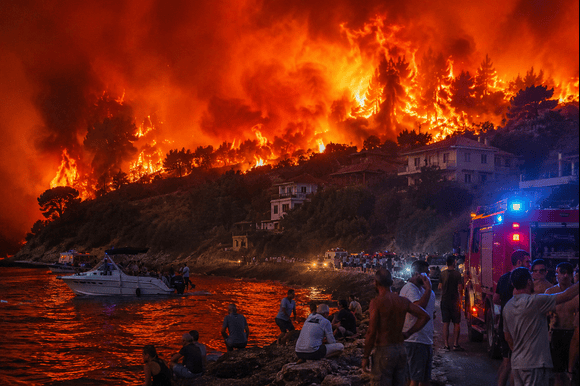
The fire caused extensive damage to homes, vehicles and other property in villages near Split. Footage from the affected areas showed huge flames and thick clouds of smoke rising over the coastline, turning the night sky bright red.
Some residents and tourists were trapped by the rapidly advancing fire and were forced to escape by sea. Several people reportedly jumped into the water from boats to avoid the flames.
Emergency shelters were established in towns along the coast as evacuation operations continued throughout the night.
During a visit to the affected region on Friday, Plenkovic said the wildfire had spread at “lightning speed” amid gale-force winds. He praised firefighters and emergency workers, saying the amount of property and infrastructure that had been saved was “truly a miracle”.
Viseslav Pesic, commander of the Omis Volunteer Fire Department, told Reuters that the intensity of the blaze forced people to abandon vehicles directly in the fire zone. The abandoned cars made it even more difficult for emergency crews to move through the affected areas.
The wildfire is part of a wider pattern of devastating fires across Europe during a summer marked by extreme heat, dry vegetation and dangerous weather conditions.
In Greece, more than 200 people were evacuated by boat from the beach resort of Agios Vasileios as wildfires spread through parts of the country. In France, more than 500 residents were forced to leave their homes after a fire erupted in the southwestern Landes region, close to an area that had already suffered severe wildfire damage.
Germany also saw major evacuations, with more than 2,000 people ordered to leave the village of Gey after a forest fire moved towards the settlement near the Belgian border.
Meanwhile, millions of people across England and Wales received emergency wildfire warnings on Friday, with authorities describing the national risk as “very high” as firefighters battled several fires in the West Midlands.
The continuing outbreaks have placed growing pressure on firefighting services across Europe, with authorities warning that prolonged heat, strong winds and exceptionally dry conditions are creating increasingly dangerous conditions for communities along the continent’s coastlines and rural areas.