

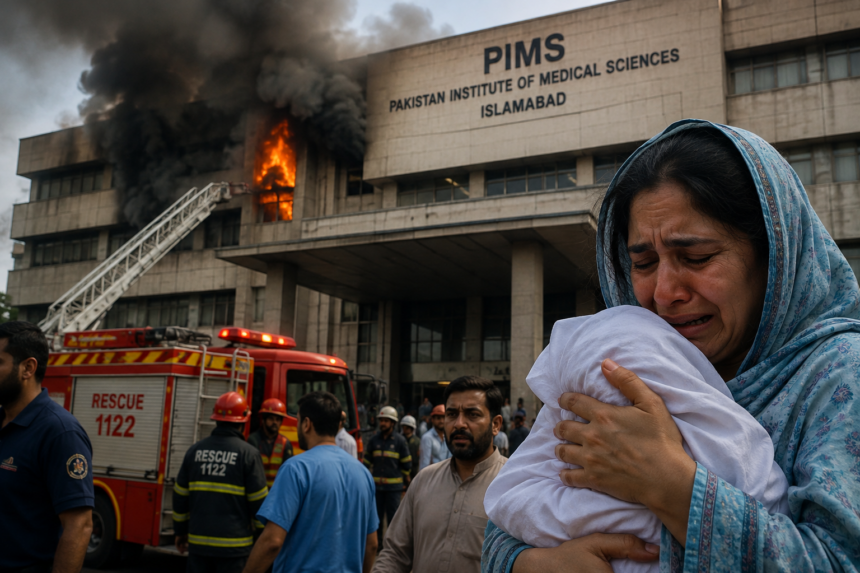
ISLAMABAD — Fourteen newborn babies have died after a devastating fire swept through a neonatal nursery at the Pakistan Institute of Medical Sciences (PIMS) in Islamabad, sparking grief across the country and raising serious concerns about fire safety and emergency preparedness at the major public hospital.
The fire broke out in the early hours of Wednesday, August 26, inside the Mother and Child Health (MCH) ward at PIMS. The affected nursery was located on the third floor and was caring for critically ill newborns who required constant medical attention, including oxygen support and incubators.
According to officials, 15 babies were inside the nursery when the fire started. Only one newborn was rescued, while 14 others lost their lives.
Fire Breaks Out in Neonatal Nursery
The blaze reportedly erupted at around 6:45am to 7:00am, with smoke and flames quickly spreading through the nursery.
Initial reports suggested that an electrical problem involving an air-conditioning unit may have triggered the fire. Federal Health Minister Mustafa Kamal said CCTV footage appeared to show a spark coming from an air conditioner shortly before the flames developed.
Because several of the newborns were receiving oxygen, the presence of oxygen in the nursery may have contributed to the rapid spread and intensity of the flames.
However, authorities have stressed that the precise cause has not yet been established. Officials and lawmakers have raised questions about whether the air-conditioning unit was actually responsible, with some reports indicating that the particular unit identified as a possible source had not been functioning for some time.
Investigators are therefore examining other possibilities, including electrical faults and problems with wiring or equipment.
Rescue Operation Underway
As the fire spread, hospital staff attempted to respond using available fire extinguishers while emergency and rescue teams were alerted.
The location of the nursery on an upper floor made the rescue operation particularly difficult. Rescue workers reportedly used ladders and accessed the affected area through windows as thick smoke and flames filled the room.
The babies inside the nursery were especially vulnerable because of their age and medical conditions. Many were dependent on incubators, oxygen and other life-support equipment and were unable to be evacuated without assistance.
Despite the efforts of hospital staff and rescuers, 14 babies could not be saved.
One newborn was successfully rescued from the affected area.
Families Left Devastated
The deaths have caused immense grief among the families of the newborns.
Parents and relatives gathered at the hospital as authorities dealt with the aftermath of the fire. The loss of so many newborn children at the same time has led to public anger, with families and members of the public demanding a complete investigation into the incident.
The bodies of the deceased infants were later handed over to their families. Funeral prayers and burials took place as relatives mourned the loss of children who had been receiving treatment at the hospital.
For the families, the tragedy has also raised painful questions about whether stronger safety measures could have prevented the deaths.
Serious Questions Over Fire Safety
The incident has brought renewed attention to fire-safety arrangements at PIMS.
One of the major concerns is the reported absence of a sprinkler system inside the affected nursery. Officials said staff attempted to control the flames with fire extinguishers after the fire was detected.
Questions have also been raised about the hospital’s overall fire-safety certification and emergency systems.
Reports citing sources have suggested that PIMS did not have the required fire-safety No Objection Certificate (NOC). If confirmed, the issue could become a significant part of the official investigation.
The absence or inadequacy of fire alarms, smoke detectors, sprinklers, emergency exits and evacuation procedures could have serious consequences in a hospital environment, particularly in neonatal and intensive-care units.
Conflicting Claims About Cause
Authorities have urged caution before assigning responsibility for the fire.
Although an air-conditioning unit was initially identified as a possible source, members of the National Assembly’s health committee said the explanation required further examination.
Officials were reportedly told that the suspected air conditioner had not been operational for some time. Other accounts have pointed to possible problems with electrical wiring.
Investigators will therefore need to establish exactly where the fire originated, what caused it to spread and whether maintenance or safety failures played a role.
The investigation is also expected to examine the actions taken by hospital staff immediately after the fire was detected and whether emergency equipment was readily available and functioning properly.
Government Orders Probe
Prime Minister Shehbaz Sharif has ordered an investigation into the incident, with authorities instructed to determine the cause of the fire and identify those responsible if negligence is established.
The government has formed a fact-finding mechanism to examine the circumstances surrounding the tragedy, including fire-safety arrangements, hospital procedures and the response of staff and emergency services.
Health Secretary Aslam Ghauri was removed from his position following the incident, adding to the pressure on hospital and health authorities.
Federal Health Minister Mustafa Kamal has said the investigation will be conducted transparently and that action will be taken against anyone found responsible.
He has also said that he would be willing to face accountability if the investigation establishes negligence on his part.
PIMS Refers Critical Cases
Following the fire, PIMS began referring some serious gynaecological cases to other hospitals as officials assessed the situation and reviewed the safety of affected areas.
Some patients have reportedly been referred to Polyclinic and hospitals in Rawalpindi to ensure that those requiring urgent treatment continue to receive medical care.
The incident has also triggered calls for broader inspections of hospitals across the country.
Fire Safety Audits Ordered
The PIMS tragedy has prompted authorities to look more closely at fire-safety arrangements in healthcare facilities.
Following the incident, authorities in Punjab ordered fresh fire-safety inspections of hospitals and called for improved emergency systems.
Modern fire alarms, smoke detectors and sprinkler systems have been highlighted as essential safety measures, particularly in areas where patients cannot evacuate independently.
Neonatal units, intensive-care wards and emergency departments require particularly strong fire-prevention and evacuation systems because patients in these areas are often dependent on medical equipment and staff assistance.
Calls for Accountability Grow
The tragedy has intensified concerns about the condition of public hospitals and the enforcement of safety regulations in Pakistan.
Families and members of the public are seeking answers about whether the hospital had adequate firefighting equipment, whether staff had received sufficient emergency training and whether electrical and air-conditioning systems were properly maintained.
There are also questions about evacuation procedures and whether the hospital’s emergency infrastructure was capable of dealing with a rapidly developing fire.
For many observers, the investigation will be crucial in determining whether the deaths were caused solely by an unexpected technical failure or whether shortcomings in safety procedures contributed to the disaster.
Condolences Pour In
The deaths have prompted widespread condolences from inside and outside Pakistan.
Several countries, including Saudi Arabia, Iran, Türkiye and the United Kingdom, have expressed sympathy to the families of the victims and conveyed solidarity with Pakistan following the tragedy.
The international condolences have reflected the shock surrounding the deaths of so many newborns in a single hospital incident.
A Tragedy That Demands Answers
The PIMS nursery fire has left 14 families mourning the deaths of their newborn children and has raised fundamental questions about patient safety in Pakistan’s healthcare system.
The final findings of the investigation are expected to establish the exact cause of the blaze, determine whether safety regulations were followed and assess the response of hospital authorities and emergency personnel.
Until those questions are answered, the tragedy will remain a stark reminder of the importance of effective fire-prevention systems, regular equipment maintenance and rapid evacuation procedures in hospitals.
For the families who lost their babies, however, the consequences are already irreversible. Their demand now is simple: that the circumstances surrounding the fire be fully investigated and that any person or institution found responsible be held accountable.