

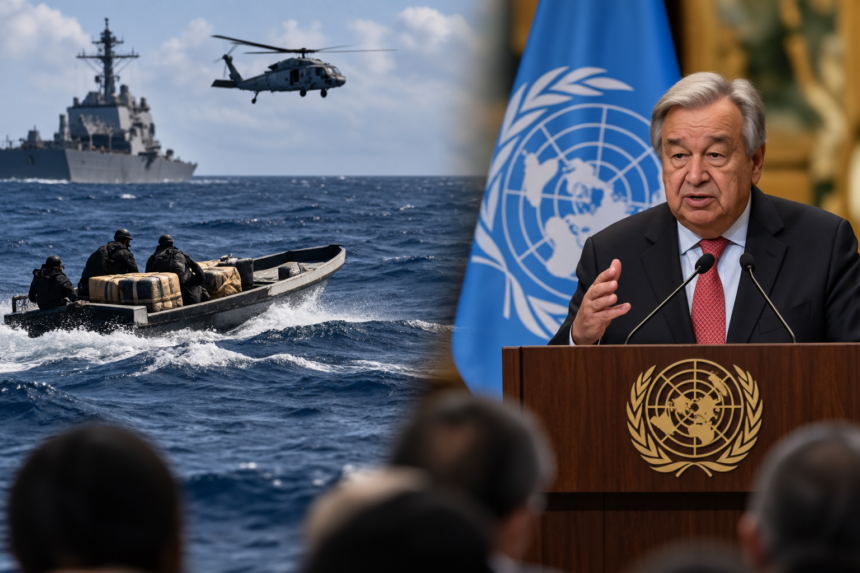
A United Nations human rights expert has raised serious legal concerns over US military strikes against boats suspected of drug trafficking, saying the operations may violate international law and could amount to crimes against humanity.
The assessment comes from Ben Saul, the UN special rapporteur on human rights and counterterrorism, who examined US operations targeting suspected drug-trafficking vessels in the Caribbean Sea and eastern Pacific Ocean.
According to Saul’s report, US forces carried out 68 attacks between September 2025 and August 2026, resulting in at least 223 deaths. The findings have intensified an international debate over whether military force can legally be used against suspected drug traffickers operating at sea.
UN Expert Questions Legal Basis for the Strikes
Saul’s report argues that drug trafficking, by itself, does not provide the same legal basis for military self-defence as an armed attack.
The UN expert said there was insufficient evidence that the criminal organizations targeted by the United States had carried out an armed attack against the US or were acting as armed proxies of another state.
The report also questioned whether lethal military force was necessary when other options, including intercepting and boarding vessels, were available.
Saul concluded that there are reasonable grounds to believe the reported killings could constitute crimes against humanity under international law. His assessment is an expert UN mandate-holder’s finding, not a final judgment by an international court.
Washington Says the Operations Target Drug Networks
The US government has described the campaign as part of its effort to disrupt drug-trafficking organizations and protect Americans from illegal narcotics.
US Southern Command has repeatedly said its forces targeted vessels operating along established drug-trafficking routes and that intelligence showed the boats were involved in narcotics operations. In one September 9 operation, the command said three people were killed aboard a vessel in the Caribbean.
US officials have also referred to the groups involved as “narco-terrorist” organizations and argued that the military campaign is aimed at dismantling their networks.
Questions Over Evidence and Effectiveness
Another major issue raised by the UN report is whether the strikes have significantly reduced the flow of illegal drugs into the United States.
The report says available evidence does not demonstrate a substantial reduction in cocaine entering the country. It also points out that significant quantities of cocaine are transported using commercial shipping routes rather than the small vessels targeted by the military campaign.
The report further argues that the operations have focused heavily on cocaine while fentanyl and other opioids remain major contributors to drug-related deaths in the United States.
Latest Strike Adds to Controversy
The UN assessment comes shortly after another US strike in the Caribbean.
The US military said four people were killed in a September 19 operation against a vessel it suspected of drug smuggling. US authorities said the boat was operating along a known trafficking route, but publicly available information has provided limited details about the evidence used to identify the vessel’s occupants.
The continuing operations have prompted questions from human rights organizations and international legal experts about the use of lethal force against people who have not been publicly charged or brought before a court.
What Happens Next?
Saul has called for investigations into the deaths and urged authorities to establish accountability where unlawful killings are found. He also recommended that victims’ families receive appropriate remedies.
The dispute is likely to remain a significant international legal issue as the United States continues its campaign against suspected drug-trafficking networks in the Caribbean and Pacific.
For now, the UN findings represent the assessment of an independent UN-appointed expert. Whether any individual operation violated international law would ultimately depend on further evidence, investigations and, where applicable, judicial proceedings.