


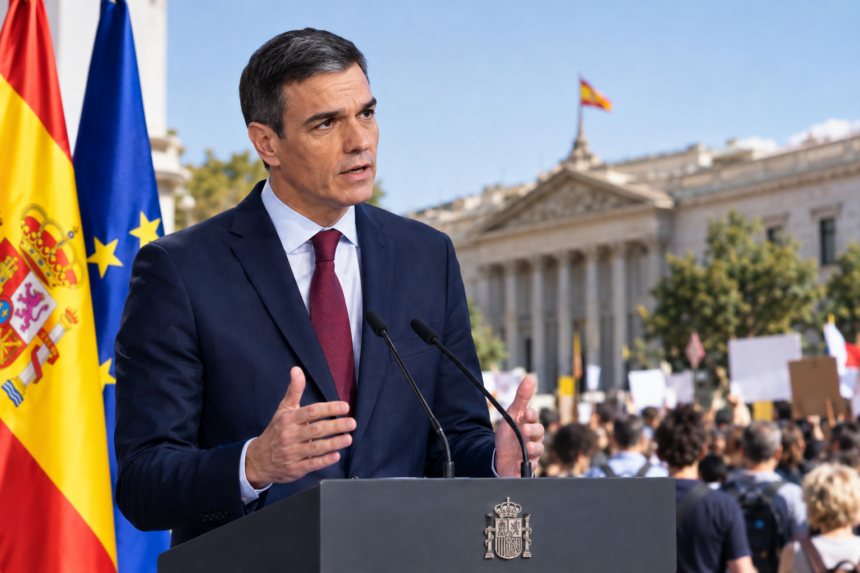
Spanish Prime Minister Pedro Sánchez has called a general election for 29 November, bringing Spain’s next national vote forward after his minority government suffered a major parliamentary defeat over measures intended to address the country’s housing crisis.
The announcement came after lawmakers rejected two government-backed housing decrees designed to strengthen protections for renters and respond to rapidly rising housing costs. The defeat added to pressure on Sánchez’s coalition and raised questions about its ability to pass major legislation.
Housing has become one of Spain’s most politically sensitive issues. Large demonstrations have taken place in cities including Madrid, Barcelona and Valencia, with protesters demanding more affordable homes and stronger protection for tenants.
Public anger intensified following the eviction of an 87-year-old woman from her Madrid home after a substantial increase in her rent. Her case became a symbol of Spain’s wider affordability problems and helped fuel the latest wave of demonstrations.
Sánchez said Spain needed a stronger parliamentary mandate to continue its reform agenda. In his announcement, he argued that a broader progressive majority would be needed to tackle inequality, improve public services and expand access to housing.
His Socialist Party governs in coalition with the left-wing Sumar alliance but lacks an outright majority in Parliament. The government has therefore depended on support from smaller political groups to pass legislation, making parliamentary defeats increasingly difficult to overcome.
The failed housing package included measures aimed at protecting vulnerable renters from eviction, extending some rental agreements and addressing speculative activity in the housing market. Critics from the political right argued that government intervention could discourage landlords from offering properties and potentially push rents higher.
The election also comes as Sánchez faces broader political challenges. His government has been under pressure from corruption-related investigations involving figures close to the Socialist Party, as well as disputes over migration and other cost-of-living concerns.
The opposition People’s Party welcomed the election announcement. Its leader, Alberto Núñez Feijóo, said voters would now have the opportunity to determine the country’s political direction.
Opinion polling has generally placed the People’s Party ahead of Sánchez’s Socialists, although forming a government could depend on negotiations with other parties, including the right-wing Vox.
Sánchez has been prime minister since 2018 and was expected to remain in office until the next scheduled election period in 2027. The November vote will now give Spanish voters an earlier opportunity to decide whether his progressive coalition should continue governing.
The election campaign is expected to focus heavily on housing affordability, alongside corruption, migration, public services and the broader direction of Spain’s economy and social policies.