


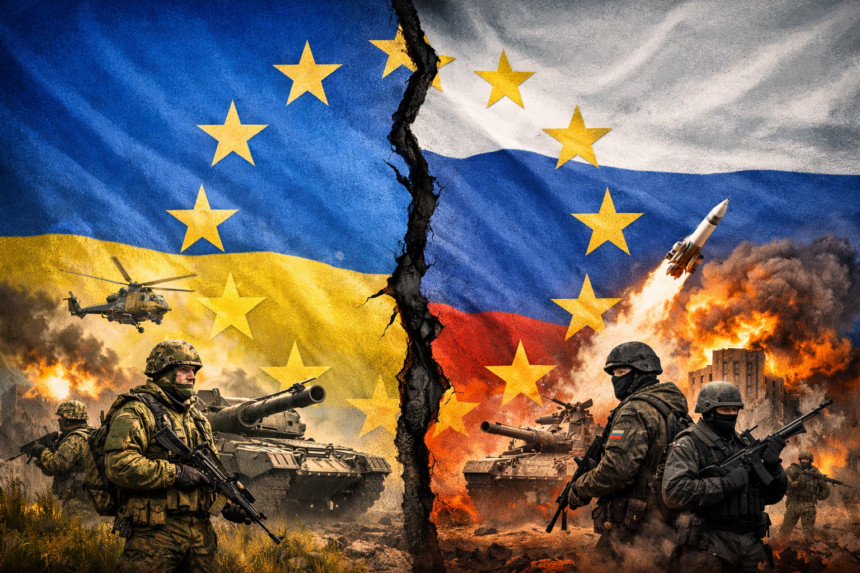
Ukrainian President Volodymyr Zelensky has appealed to European Union leaders meeting at a critical summit in Brussels to approve a plan that would allow Kyiv to borrow billions of euros from frozen Russian state assets to meet Ukraine’s urgent military and economic needs.
Around €210bn (£185bn; $245bn) of Russian assets are currently immobilised inside the EU, the majority of them held by the Belgium-based financial services company Euroclear. While the EU has already been channeling the interest earned on these funds to Ukraine, Belgium and several other member states have resisted proposals to use the assets themselves, warning against turning the money into what some describe as a “reparations loan”.
Russia has repeatedly cautioned the EU against touching the frozen funds and has warned of serious consequences if they are used. However, without a significant injection of new financing, Ukrainian officials say the country’s finances could be exhausted within months.
“I hope we will be able to get a positive decision,” Zelensky told reporters in Brussels. “Without this, there will be a big problem for Ukraine.” The summit comes at a decisive point in the war, as Russia has launched a lawsuit in a Moscow court against Euroclear in an effort to reclaim its frozen assets.
One senior European government official said expectations were guarded. “We are cautiously optimistic, not overly optimistic,” the official said. European Commission President Ursula von der Leyen struck a more confident tone, insisting: “We will not leave the summit without a solution.”
Much of the attention has focused on Belgian Prime Minister Bart De Wever, whose country hosts Euroclear and therefore carries particular legal and financial exposure. Addressing the Belgian parliament on Thursday, De Wever said: “I haven’t yet seen any text that would persuade me to change Belgium’s position.”
The diplomatic push comes as US President Donald Trump claimed that an agreement to end the war is closer than ever. According to a White House official quoted by AFP, American and Russian officials are expected to meet in Miami this weekend for further discussions on a peace proposal. Kremlin envoy Kirill Dmitriev is believed to be scheduled to meet Trump advisers Steve Witkoff and Jared Kushner.
Ukrainian officials are also travelling to the United States, while Zelensky, speaking in Brussels, stressed that Kyiv needs the money regardless of whether the fighting continues or a settlement is reached. He said the funds would either help sustain Ukraine’s armed forces or be redirected entirely towards post-war recovery.
Moscow has yet to formally respond to the latest peace initiatives, but the Kremlin has made clear that it would reject any European-led multinational force deployed to Ukraine, even if such a force were backed by the United States.
President Vladimir Putin underscored his hostility towards Europe on Wednesday, accusing the continent of “total degradation” and deriding Ukraine’s European allies as “European piglets”, suggesting they were hoping to benefit from Russia’s downfall.
Under current proposals from the European Commission, Kyiv would receive around €90bn (£79bn) in loans over the next two years, drawn from the €210bn of Russian assets frozen within the EU. This amount would cover roughly two-thirds of the estimated €137bn Ukraine is believed to require to see it through 2026 and 2027. Until now, Brussels has limited its support to transferring only the interest generated by the assets, not the principal itself.
“This is a crunch time for Ukraine to keep fighting for the next year,” a Finnish government official told the BBC. “There are of course peace negotiations, but this gives Ukraine leverage to say, ‘we’re not desperate and we have the funds to continue fighting’.”
Von der Leyen has also warned that Europe intends to further increase the cost of the war for Russia. Still, the use of frozen Russian assets is not the only option under consideration. Another proposal, supported by Belgium, would see the EU borrow money from international markets, with the EU budget acting as a guarantee.
That alternative, however, would require unanimous approval from all 27 member states. Hungary’s Prime Minister Viktor Orban has already said he will block any additional EU funds for Ukraine, making such a route highly uncertain.
For Kyiv, the coming hours are critical, and EU leaders have emphasised the gravity of the decision before them. “We know the urgency. It is acute. We all feel it. We all see it,” von der Leyen told the European Parliament. German Chancellor Friedrich Merz has been a leading advocate for tapping the Russian assets, telling lawmakers in Berlin ahead of the summit that it would send a “clear signal” to Moscow that prolonging the war serves no purpose.
EU officials insist they have a strong legal basis for using the frozen assets, but Belgium remains sceptical. Belgian Defence Minister Theo Francken warned ahead of the summit that loaning out the Euroclear funds would be a serious mistake.
Hungary is widely seen as the strongest opponent of the plan. Before the summit, Orban and members of his team even suggested the proposal had been dropped from the agenda. A European Commission official rejected that claim, saying the matter would be discussed by all 27 leaders.
Slovakia’s Prime Minister Robert Fico has also voiced opposition, particularly if the money is used to buy weapons rather than for reconstruction. When the decisive vote eventually takes place, approval will require support from at least 15 member states representing 65% of the EU’s population.
European Council President António Costa has pledged that Belgium’s concerns will not be ignored. “We’re not going to vote against Belgium,” he told Belgian broadcaster RTBF. “We’ll continue to work very intensively with the Belgian government because we don’t want to approve something that might not be acceptable for Belgium.”
Belgium is also mindful of financial risks. Ratings agency Fitch has placed Euroclear on negative watch, citing in part the “low” but notable legal risks to its balance sheet stemming from the Commission’s plans. Euroclear’s chief executive has also warned against proceeding.
“There are many hiccups and obstacles still on the way,” the Finnish official said. “We have to find a way to respond to Belgium’s worries. We are on the same side as Belgium. We will find a solution together to make sure all the risks are checked as much as they can be checked.”
Belgium is not alone in its hesitation. Support for the plan is not guaranteed, with Italy’s Prime Minister Giorgia Meloni telling parliament she would only back the proposal if the legal foundation is watertight. “If the legal basis for this initiative were not solid, we would be handing Russia its first real victory since the beginning of this conflict,” she said.
Malta, Bulgaria and the Czech Republic are also reported to be uneasy about the controversial idea. In the worst-case scenario for Belgium, a court ruling could force it to return the frozen funds to Russia if the legal framework collapses.
Some EU countries have indicated they would be willing to provide billions of euros in financial guarantees to reduce Belgium’s exposure, but Brussels will want firm assurances that the figures add up.
European Commission officials argue that, ultimately, the only way Russia could recover its assets would be by paying reparations to Ukraine. In that scenario, Ukraine would repay the EU the money it received under what officials describe as a “reparations loan”, closing the financial loop.