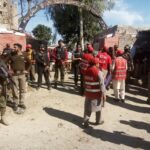



Hezbollah has announced that its top military commander, Haytham Ali Tabatabai, has been killed in an Israeli air strike targeting a residential building in southern Beirut’s Dahiyeh district, a stronghold of the group. At least five people were killed in the attack on Sunday, making Tabatabai the most senior Hezbollah figure eliminated by Israel since a ceasefire began in November 2024, following more than a year of cross-border hostilities.
In an official statement, Hezbollah said the “great commander” died in a “treacherous Israeli attack on the Haret Hreik area”, though his exact role was not specified. Israeli authorities confirmed their forces “eliminated” Tabatabai, with Prime Minister Benjamin Netanyahu’s office stating he was the primary target. Reports from Israeli media suggest it was their third attempt to eliminate him since last year’s conflict.
Israeli strike dubbed ‘red line’
Mahmoud Qmati, a senior Hezbollah official, warned that the strike violated a red line, stating that leadership is now considering its response. He cautioned that the attack could pave the way for wider military escalation across Lebanon.
According to Lebanon’s Ministry of Public Health, 28 people were injured in the air strike. The Lebanese National News Agency (NNA) reported that two missiles struck an apartment building on al-Arid Street, causing extensive destruction to both vehicles and surrounding infrastructure.
Commander’s background
Born in 1968 in Beirut to a Lebanese mother and Iranian father, Tabatabai grew up in southern Lebanon and is believed to have joined Hezbollah in the 1980s. He served as chief of staff of the militant group’s armed wing, one of its most influential military figures.
Rising tensions in Lebanon
Reporting from Beirut, Al Jazeera’s Zeina Khodr said there are growing fears that Israel, “acting with impunity”, may expand its strikes. She added that Hezbollah is in a difficult position — either respond and risk triggering a larger conflict that could alienate its supporters, or refrain and appear weakened.
Security analyst Ali Rizk told Al Jazeera that a full-scale retaliation is unlikely, as Hezbollah may avoid giving Israeli Prime Minister Benjamin Netanyahu justification for a broader conflict. He suggested Netanyahu may use such an escalation to strengthen his political position.
Political reactions
Lebanese President Joseph Aoun appealed to the international community to step in decisively to stop ongoing Israeli attacks. He reiterated calls for urgent intervention to protect Lebanon and its citizens.
Hezbollah MP Ali Ammar stated that Israel has consistently struck Lebanon since the US-brokered ceasefire roughly a year ago, saying, “Every attack on Lebanon is a crossing of a red line.” He accused Israel of violating national sovereignty and attempting to undermine Lebanon’s security and dignity.
Escalating aggression beyond the capital
While Beirut had been spared major attacks in recent months, Israeli air raids on southern Lebanon have continued almost daily. Earlier this week, at least 13 people were killed in a strike on a Palestinian refugee camp in southern Lebanon. According to NNA, a drone targeted a vehicle in the car park of a mosque in Sidon’s Ein el-Hilweh camp.
In recent months, both Israel and the US have pressured Lebanon to dismantle Hezbollah’s military capabilities. The Lebanese government approved a plan in September to disarm the group by the end of the year, but Hezbollah refuses to disarm until Israeli strikes cease and occupied southern regions are vacated.
Diplomatic significance
Sunday’s strike took place just days before Pope Leo XIV’s expected visit to Lebanon, adding to concerns over potential further escalation amid heightened Israeli military actions.