


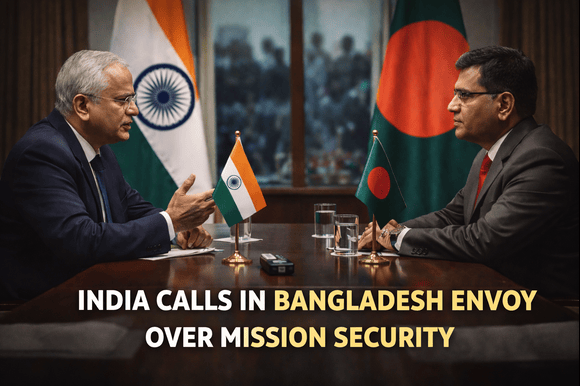
India has formally protested to Bangladesh over what it described as a worsening security environment surrounding its diplomatic mission in Dhaka, amid rising political tensions ahead of Bangladesh’s upcoming elections.
On Wednesday, India’s Ministry of External Affairs summoned Bangladesh’s envoy to New Delhi, Riaz Hamidullah, to register its concerns about the activities of what it called “extremist elements” operating near Indian diplomatic facilities. In a statement, the ministry said it had conveyed India’s expectation that Bangladesh’s interim authorities would fulfil their diplomatic obligations by ensuring the safety and security of Indian missions and personnel.
“We expect the interim government to ensure the safety of Indian missions and posts in Bangladesh in keeping with its diplomatic obligations,” the ministry said, adding that the security situation had become a matter of serious concern.
The protest follows demonstrations in Bangladesh in which protesters reportedly began marching towards the Indian High Commission in Dhaka, demanding the repatriation of former prime minister Sheikh Hasina. Hasina has been living in exile in India since she was forced from office last year after student-led protests spiralled into nationwide unrest. Bangladesh has not yet issued an official response to India’s latest statement.
The diplomatic exchange comes only days after Bangladesh summoned India’s envoy in Dhaka on Sunday to object to what it described as “incendiary statements” allegedly made by Hasina from Indian territory. Dhaka accused her of attempting to influence and undermine the country’s forthcoming elections.
Bangladesh is scheduled to hold national elections on 12 February under an interim government led by Nobel Peace Prize laureate Muhammad Yunus, which assumed power after Hasina fled to India in August 2024. India, however, said it “categorically rejects the assertions” made by Bangladesh regarding Hasina’s remarks.
Relations between the two neighbours have deteriorated sharply since Hasina’s departure. Bangladeshi authorities have repeatedly called on India to extradite the former leader so that she can face trial over alleged crimes linked to the violent suppression of protests during her final months in office.
Last month, a Bangladeshi court sentenced Hasina to death after finding her guilty of authorising the use of lethal force against demonstrators, during unrest in which an estimated 1,400 people were killed. Hasina has rejected the verdict, calling it politically motivated and accusing the interim government of attempting to eliminate her party, the Awami League, as a political force. She has also said she remains proud of her government’s human rights record.
The conviction has placed additional strain on India-Bangladesh relations. Political rhetoric has also intensified inside Bangladesh, with reports on Monday that Hasnat Abdullah, a leader of the National Citizen Party (NCP), warned that Dhaka could shelter separatist groups to isolate India’s northeastern region if New Delhi sought to destabilise Bangladesh.
His comments were widely interpreted as referring to India’s narrow Siliguri Corridor, a strategically vital strip of land connecting the rest of India to its seven northeastern states, often referred to as the “Seven Sisters”. The corridor has long been seen by Indian strategists as a sensitive economic and security vulnerability.
In its statement, India’s foreign ministry said it “completely rejects the false narrative sought to be created by extremist elements regarding certain recent events in Bangladesh”. It also criticised the interim government for failing to conduct a thorough investigation into incidents affecting Indian interests or for sharing credible evidence with New Delhi.
“It is unfortunate that the interim government has neither conducted a thorough investigation nor shared meaningful evidence with India regarding the incidents,” the ministry said.
As election day approaches, Bangladesh has seen a surge in political agitation, with reports of multiple protests and heightened security alerts across the country in recent weeks. Reflecting the growing unease, India earlier this week temporarily closed its visa application centre in Dhaka, announcing that appointments scheduled for the latter half of the day would be postponed and rescheduled at a later time.