


UAE — Saturday, February 28, 2026
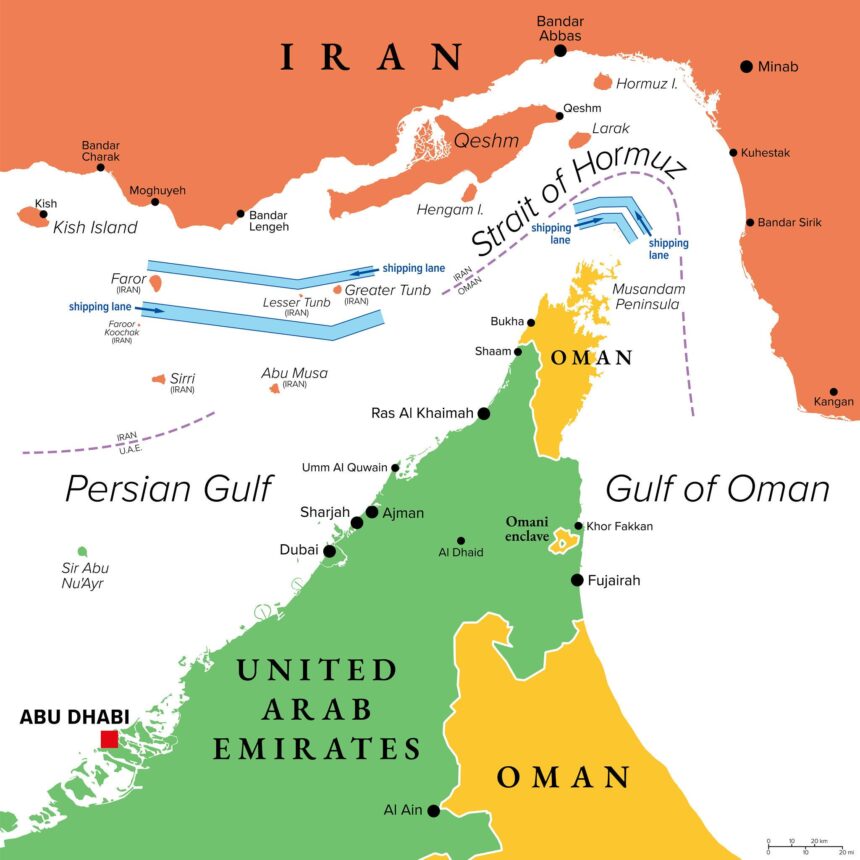
In a dramatic escalation of Middle East tensions following joint U.S. and Israeli airstrikes on Iran, Iranian forces have moved to shut down maritime traffic through the Strait of Hormuz, according to multiple military and shipping sources.
Officials from the European Union naval mission “Aspides” report that vessels transiting the waterway have received high-frequency radio messages from Iran’s Revolutionary Guards, stating that “no ship is allowed to pass the Strait of Hormuz.”
The Strait of Hormuz, a narrow marine corridor linking the Persian Gulf to the Gulf of Oman and the Arabian Sea, is vital for global energy exports. About 20 % of the world’s crude oil and significant liquefied natural gas (LNG) volumes normally transit through this chokepoint each day.
Commercial tanker operators and major oil traders have already suspended shipments through the route, while war-risk warnings are being issued for all civilian and commercial traffic in the broader Gulf region.
The United Kingdom and U.S. navies have urged caution, warning that Iran’s actions do not yet constitute a confirmed legal blockade, but noted that the safety of navigation is deteriorating due to military activity.
Global markets have responded sharply: crude oil prices surged on fears of a prolonged disruption to Middle Eastern energy exports, as analysts warn that even a short disruption in Hormuz could dramatically tighten global oil supplies.
Political leaders worldwide are calling for de-escalation and diplomatic engagement, as the closure of the Strait of Hormuz, even temporarily, could have far-reaching consequences on shipping, energy markets, and international security.