


Officials from Thailand and Cambodia are set to hold talks next week on whether a ceasefire can be revived, Thailand’s foreign minister has said, as deadly clashes along their shared border stretch into a third consecutive week.
The renewed diplomatic effort comes after an earlier ceasefire agreement, signed by both sides in July and brokered by US President Donald Trump, collapsed earlier this month. Since fighting resumed, Bangkok and Phnom Penh have repeatedly accused each other of violating the truce and provoking fresh hostilities.
Senior representatives from the two countries met on Monday on the sidelines of a regional summit in Malaysia, marking their first face-to-face discussions since the violence reignited.
Speaking after the meeting, Thailand’s Foreign Minister Sihasak Phuangketkeow said the July ceasefire had been agreed too hastily. He suggested the agreement was rushed in order to align with a visit by President Trump, rather than being fully grounded in realities on the ground.
“We were sometimes in a rush because the US wanted it signed in time for the visit of President Trump,” Mr Phuangketkeow said. “But sometimes we really just need to sit down and thrash things out, to make sure that any ceasefire truly reflects the situation on the ground and is one that can actually hold.”
He added that military officials from both Thailand and Cambodia are scheduled to meet on 24 December, stressing that such talks between defence leaders would be a necessary step before any new ceasefire agreement could be finalised.
Cambodia has not yet publicly commented on Thailand’s remarks or confirmed its position on the proposed talks.
The fighting has had a devastating humanitarian impact. At least 41 people have been killed and close to one million residents have been displaced since hostilities resumed earlier this month, according to officials and aid agencies.
Both governments have traded blame for the escalation, as clashes have intensified along the roughly 800-kilometre (500-mile) border separating the two countries. Recent fighting has included sustained exchanges of artillery fire, while Thailand has also carried out air strikes targeting Cambodian positions.
The issue has drawn urgent attention from regional leaders. At the Association of Southeast Asian Nations (Asean) meeting on Monday, Malaysia’s Foreign Minister Mohamad Hasan urged both sides, as well as other Asean members, to treat the crisis as a priority.
“We must consider the wider ramifications of the continued escalation of the situation for the people we serve,” he told fellow ministers, according to AFP.
The conflict is regarded as the most serious confrontation between Asean member states since the bloc was established in 1967, and analysts say the failure to contain it poses a significant challenge to the organisation’s credibility.
Beyond the region, both the United States and China have been actively seeking to mediate a new ceasefire. China’s special envoy for Asian affairs, Deng Xijun, visited Cambodia’s capital, Phnom Penh, last week. In a statement, Beijing said he had reaffirmed China’s commitment to playing a constructive role in encouraging dialogue between Cambodia and Thailand.
On Monday, Chinese foreign ministry spokesperson Lin Jian said during a regular press briefing that China had been pursuing mediation efforts “in its own way” since fighting resumed this month. He added that details of Deng’s mediation activities would be released at a later stage.
The dispute between Thailand and Cambodia stretches back more than a century, rooted in unresolved border demarcations and competing territorial claims. Over the years, sporadic clashes have erupted, leaving both soldiers and civilians dead on either side.
Tensions escalated sharply in May after a Cambodian soldier was killed during a border clash. The situation worsened dramatically on 24 July, when Cambodia launched a rocket barrage into Thai territory, prompting retaliatory Thai air strikes. That exchange triggered five days of intense fighting, resulting in dozens of military and civilian casualties.
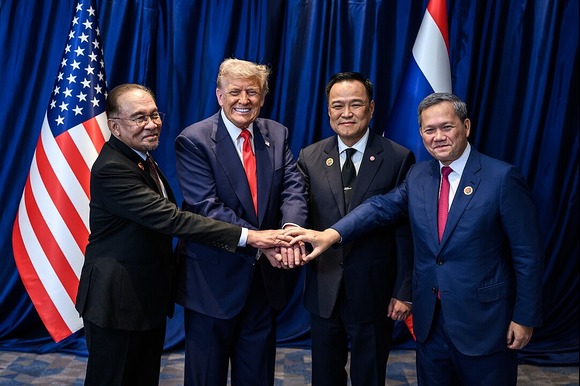
In the aftermath, the two countries agreed to an “immediate and unconditional ceasefire” brokered by Malaysian Prime Minister Anwar Ibrahim and US President Donald Trump. At the time, Mr Trump warned that Washington would suspend tariff negotiations unless the fighting stopped.
The US president later presided over the signing of what he described as the “Kuala Lumpur peace accord” in October. Thailand, however, rejected that label, instead referring to the document as the “Joint Declaration by the prime ministers of Thailand and Cambodia on the outcomes of their meeting in Kuala Lumpur”.
Despite the fanfare, the ceasefire unravelled in December. Both sides accuse the other of reigniting the conflict, which has since been marked by renewed air strikes, artillery exchanges and escalating violence along the border.