


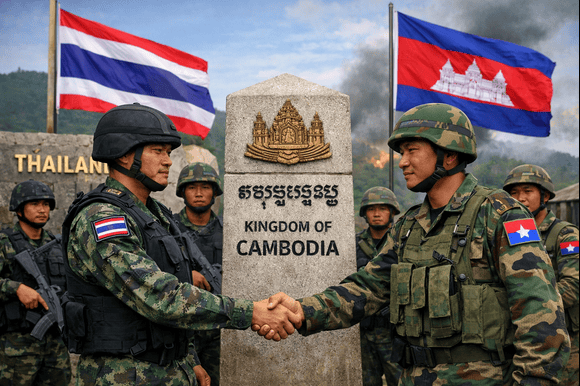
Thailand and Cambodia have agreed to an immediate ceasefire, according to a joint statement issued by the defence ministers of both countries, raising hopes of an end to nearly three weeks of intense fighting along their disputed border.
Under the agreement, both sides will halt military operations and freeze troop positions at current front lines. Civilians displaced by the fighting will be allowed to return to their homes, bringing a pause to clashes that are believed to have killed hundreds of soldiers and forced close to one million people to flee border regions.
The ceasefire came into effect at noon local time on Saturday (05:00 GMT). The statement said that once the truce has held for 72 hours, Thailand will release 18 Cambodian soldiers who have been in Thai custody since July.
The breakthrough follows several days of negotiations between Bangkok and Phnom Penh, supported diplomatically by China and the United States. The agreement places priority on facilitating the safe return of displaced civilians and also includes provisions for clearing landmines from affected areas.
Thailand’s Defence Minister, Natthaphon Narkphanit, described the ceasefire as a test of Cambodia’s intentions, warning that Thailand would respond if the agreement were breached.
“If the ceasefire fails to take hold or is violated, Thailand reserves its legitimate right to self-defence under international law,” he told reporters.
Thailand had previously resisted calls for another ceasefire, arguing that an earlier truce was never properly enforced. Thai officials have also expressed frustration over what they view as Cambodia’s attempts to draw international attention to the conflict.
Unlike the previous ceasefire agreed in July, US President Donald Trump was not directly involved in brokering the latest deal, although the US State Department played a role behind the scenes. The July ceasefire collapsed earlier this month when fresh fighting broke out along the border.
Both governments have accused each other of responsibility for the renewed clashes.
The Thai army said its forces had responded after Cambodian troops opened fire in Thailand’s Si Sa Ket province, an incident in which two Thai soldiers were wounded.
Cambodia’s defence ministry, however, said Thai forces initiated the attack in Preah Vihear province and insisted that Cambodian troops did not retaliate.
Violence continued throughout December, with Thailand launching additional air strikes inside Cambodian territory on Friday. The Thai Air Force said it targeted a Cambodian “fortified military position” after ensuring civilians had evacuated the area.
Cambodia’s defence ministry rejected that account, condemning the strikes as “indiscriminate attacks” on civilian homes.
Whether the new ceasefire will endure remains uncertain, as nationalist sentiment has surged in both countries, complicating efforts to reach a lasting settlement.
Cambodia, in particular, has suffered heavy losses in recent fighting, including significant casualties among its troops and the destruction of military equipment. Cambodian forces have been pushed back from positions they previously held along the border, while Thai air strikes have caused widespread damage — grievances that could hinder prospects for long-term peace.
The roots of the border dispute stretch back more than a century, but tensions escalated earlier this year after a group of Cambodian women sang patriotic songs at a temple located in a contested area.
In May, a Cambodian soldier was killed during a confrontation, and two months later, in July, five days of heavy fighting erupted along the border. That violence left dozens of soldiers and civilians dead and displaced thousands more.
Following diplomatic intervention by Malaysia and President Trump, a fragile ceasefire was negotiated and signed in late October. Trump hailed the deal as the “Kuala Lumpur Peace Accords”.
The agreement required both sides to withdraw heavy weapons from the disputed zone and establish an interim observer mission to monitor compliance.
However, Thailand suspended the accord in November after several Thai soldiers were injured by landmines. Thai Prime Minister Anutin Charnvirakul said at the time that the security situation had “not actually decreased,” effectively ending the truce and paving the way for renewed fighting.