

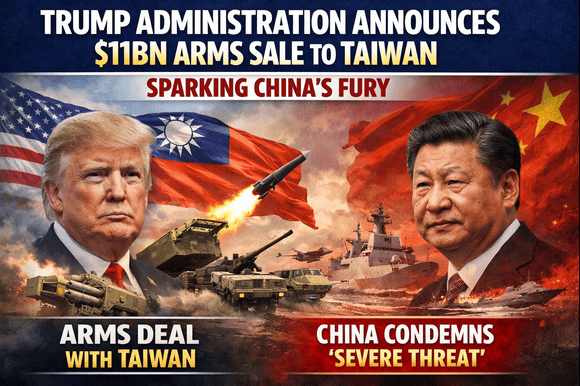
The Trump administration has unveiled a massive arms sale to Taiwan valued at approximately $11 billion (£8.2 billion), encompassing advanced rocket launchers, self-propelled howitzers, and a range of missiles.
This proposed package, which still requires approval from the US Congress, would mark the second arms deal with Taiwan since Donald Trump returned to the White House in January.
China, which considers Taiwan a breakaway province, strongly condemned the announcement, asserting that it “severely undermines China’s sovereignty, security, and territorial integrity.”
Taiwan’s Ministry of Defence expressed gratitude to the United States, stating that the deal will assist the island in “rapidly building robust deterrence capabilities.” While the US maintains formal diplomatic relations with Beijing rather than Taipei, it has historically been a powerful supporter of Taiwan and its largest supplier of military hardware.
The announcement has further aggravated Beijing, which in recent years has increased pressure on Taiwan through military exercises and frequent incursions into Taiwanese waters and airspace.
“The US’s attempt to support independence through force will only backfire, and its attempt to contain China by using Taiwan will absolutely not succeed,” said Chinese Foreign Ministry spokesman Guo Jiakun. “It will only accelerate the push towards a dangerous and violent situation across the Taiwan Strait,” he added.
The latest package includes High Mobility Artillery Rocket Systems (Himars) valued at $4 billion and self-propelled howitzers also worth $4 billion, according to the US Defense Security Cooperation Agency, which disclosed the details late Wednesday.
If approved, the size of this arms sale would far exceed the 19 rounds of sales totaling $8.38 billion during the previous Biden administration. During his first term, Trump had sanctioned arms sales to Taiwan totaling $18.3 billion, with the largest individual package worth $8 billion.
The US State Department emphasized that the deal aligns with Washington’s interests by supporting Taipei’s ongoing efforts to modernize its armed forces and maintain a credible defensive capability.
China has long maintained its goal of “reunifying” with Taiwan and has not ruled out the use of force to achieve it. This remains a significant concern for Taipei, which plans to increase defense spending to over 3% of its gross domestic product next year and up to 5% by 2030.
In October, Taiwanese President Lai Ching-te announced plans to construct a dome-like air defense system aimed at countering “hostile threats,” without explicitly naming China.
China’s increasingly assertive posture in the region has also alarmed neighboring countries. In June, Japan lodged a protest after Chinese aircraft carriers conducted an unprecedented naval drill in the Pacific.
Tensions between the two countries have intensified recently, particularly over comments by Japan’s Prime Minister suggesting that Japan might deploy its self-defense forces in the event of a Chinese attack on Taiwan.
This month, confrontations between boats from both sides occurred near disputed islands, and Chinese fighter jets locked radar onto Japanese aircraft, further heightening regional concerns.