

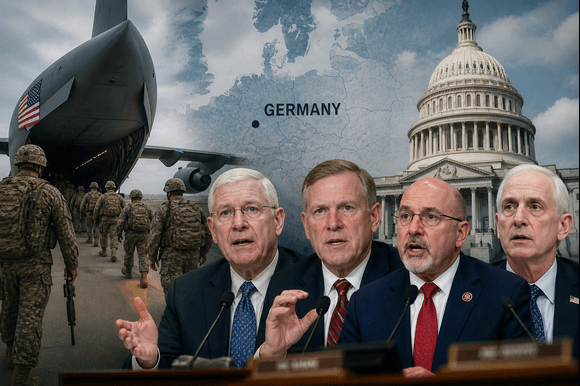
Two senior Republican lawmakers in the United States have sharply criticised a Pentagon decision to withdraw 5,000 American troops from Germany, warning that the move could weaken deterrence in Europe and send an unfavorable signal to Russia.
Roger Wicker and Mike Rogers, who chair the Senate and House Armed Services Committees respectively, argued that instead of pulling forces out of Germany, the United States should consider repositioning them further east to reinforce NATO’s frontline presence.
A Pentagon spokesperson, Sean Parnell, said on Friday that the decision followed a comprehensive review and was based on “theater requirements and conditions on the ground.” The move, he added, reflects evolving strategic priorities.
On Saturday, US President Donald Trump indicated that the reduction could go even further, though he did not provide specifics. Currently, the United States maintains more than 36,000 active-duty troops in Germany, its largest military footprint in Europe.
Germany’s Defence Minister Boris Pistorius described the decision as “foreseeable,” but emphasized that the presence of American troops remains mutually beneficial. Speaking to the DPA news agency, he noted that US forces in Germany serve both European and American security interests.
Meanwhile, the NATO alliance has sought clarification from Washington regarding the withdrawal. Concerns are growing within the 32-member bloc that a reduction in US forces could undermine collective security at a critical time.
In a joint statement, Wicker and Rogers expressed “serious concern” over what they described as a premature withdrawal. They warned that reducing America’s forward military presence before Europe’s own defence capabilities are fully strengthened risks weakening deterrence and could embolden Russian President Vladimir Putin.
“Rather than withdrawing forces from the continent altogether, it is in America’s interest to maintain a strong deterrent in Europe by moving these 5,000 troops to the east,” the lawmakers said.
Criticism also came from across the aisle. Adam Smith, the senior Democrat on the House Armed Services Committee, argued that the decision lacks a coherent national security strategy. He suggested it was driven more by political motives than by careful analysis, calling it an example of “political vengeance.”
However, not all Republicans opposed the move. Clay Higgins voiced support for the administration’s decision, while also mocking what he described as inefficiency in the Senate. In a post on X, he quipped that withdrawing troops from Germany might be fitting given what he called the country’s “arrogance.”
The Pentagon’s decision comes amid rising tensions between Washington and Berlin. President Trump recently criticised German Chancellor Friedrich Merz after Merz suggested the United States had been “humiliated” by Iranian negotiators during ongoing conflict-related discussions.
The US military presence in Germany remains significantly larger than in other European countries, with around 12,000 troops stationed in Italy and approximately 10,000 in the United Kingdom. Nonetheless, Trump has hinted at broader reductions, even suggesting potential troop withdrawals from Italy and Spain.
Last year, the United States also reduced its troop presence in Romania as part of a broader strategic shift toward the Indo-Pacific region, reflecting changing global priorities.
The latest development has sparked broader चिंता within NATO. Polish Prime Minister Donald Tusk warned that the greatest threat to the transatlantic alliance may not be external adversaries but internal fragmentation.
“We must all do what it takes to reverse this disastrous trend,” Tusk said, underscoring fears that weakening unity could have long-term consequences for collective defence.
Trump has previously criticised Germany for failing to meet NATO’s defence spending target of 2% of GDP. However, that situation has changed significantly in recent years. Under the leadership of former Chancellor Olaf Scholz and now Merz, Germany is projected to spend €105.8 billion on defence by 2027.
Overall, Germany’s defence expenditure is expected to reach 3.1% of GDP when including additional funds such as military aid to Ukraine in its ongoing war against Russian forces.
In a statement posted on X, NATO spokesperson Allison Hart said the alliance is working closely with the United States to better understand the details of the troop withdrawal. She added that the move highlights the need for European allies to increase defence spending and assume a greater share of responsibility for collective security.
“We’re already seeing progress since allies agreed to invest 5% of GDP at the NATO summit in The Hague last year,” she noted.
The dispute between Trump and Merz intensified after the German chancellor told students earlier in the week that the United States appeared to lack a clear strategy in its dealings with Iran. He also remarked that the country had been “humiliated” in negotiations.
Trump responded on his Truth Social platform, accusing Merz of misunderstanding the situation and suggesting that the German leader was effectively supportive of Iran acquiring nuclear weapons.
Shortly after the exchange, the Pentagon confirmed that the troop withdrawal decision had been authorized by Defence Secretary Pete Hegseth. According to spokesperson Sean Parnell, the withdrawal is expected to be completed within six to twelve months.
The move marks a significant shift in US military posture in Europe and raises pressing questions about the future of transatlantic security cooperation at a time of heightened geopolitical uncertainty.