

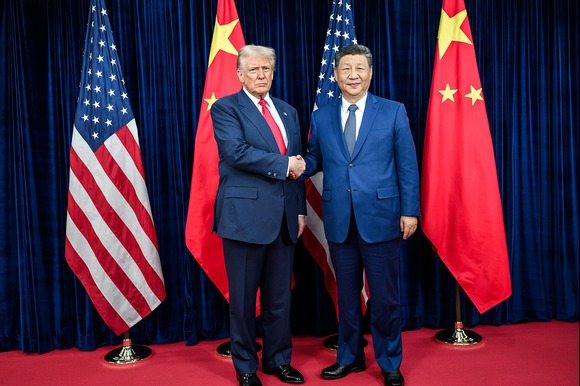
Beijing has officially confirmed that US President Donald Trump will travel to China this week for a crucial summit with Chinese President Xi Jinping, marking the first visit to China by a sitting American president in nearly a decade.
The three-day visit, scheduled from 13 to 15 May, comes at a critical moment in relations between the world’s two largest economies, as both nations attempt to stabilise a fragile trade truce while managing growing tensions over technology, global supply chains, and the ongoing Iran conflict.
Senior executives from several major American corporations, including Boeing, Citigroup, and Qualcomm, are expected to accompany Trump during the trip. Analysts believe the visit could lead to major commercial agreements between US and Chinese companies as Washington seeks to improve economic ties while maintaining strategic pressure on Beijing.
The meeting is also being viewed as a major test for the temporary trade truce reached between the two powers after years of escalating tariffs and economic retaliation.
How the US-China Trade War Began
The roots of the current dispute stretch back to Trump’s first term in office. After winning the 2016 presidential election, Trump pledged to reshape global trade rules in favour of the United States and revive American manufacturing industries.
In 2018, the Trump administration imposed tariffs on approximately $250 billion worth of Chinese imports, a move widely regarded as the formal beginning of the US-China trade war. Trump argued that China’s trade practices unfairly harmed American businesses and workers.
The administration also targeted other major trading partners, including Mexico, Canada, and European nations, accusing them of benefiting disproportionately from trade with the United States.
The sweeping tariff measures shocked global markets and caught Beijing off guard. Policy experts say Chinese officials initially underestimated Trump’s willingness to pursue aggressive economic measures against China.
At the time, China relied heavily on exports to the United States, with American consumers representing a major market for Chinese manufactured products. Higher tariffs threatened factory activity, employment, and economic growth across China.
The trade tensions also intensified deeper economic problems already facing China, including weak domestic spending, rising youth unemployment, and a prolonged crisis in the country’s property sector.
Biden Continued Pressure on Beijing
When Joe Biden entered the White House in 2021, many expected a softer approach toward Beijing. Instead, the Biden administration largely maintained Trump-era tariffs and expanded restrictions on Chinese technology firms.
Biden’s administration argued that Washington needed to slow China’s rapid technological rise, particularly in sectors such as
semiconductors, artificial intelligence, and telecommunications.
Chinese technology giant Huawei faced strict US sanctions over national security concerns and was effectively pushed out of the American market. The popular video-sharing platform TikTok also came under increasing scrutiny, eventually separating its US operations from its Chinese parent company.
The Biden administration additionally imposed steep tariffs on Chinese electric vehicles, effectively blocking many Chinese EV manufacturers from entering the American market.
Some economists argue that Biden’s trade policies were even more protectionist than Trump’s first-term measures, as Washington increasingly focused on limiting China’s influence in strategic industries.
Trump Returns With Tougher Tariffs
Following his return to office in 2025, Trump quickly revived and expanded his aggressive tariff strategy.
The administration imposed a new 20% tariff on Chinese imports, accusing Beijing of failing to stop the flow of fentanyl-related chemicals into the United States. On what Trump called “Liberation Day,” Washington announced an additional 34% levy on Chinese goods, pushing total tariffs on some products to historically high levels.
The measures created significant disruptions for businesses on both sides of the Pacific. Chinese exporters faced falling demand and rising warehouse inventories, while many US companies struggled to secure alternative suppliers.
Beijing responded swiftly with retaliatory tariffs targeting American agricultural products, including soybeans and other farm exports, directly impacting rural states that form a core part of Trump’s political support base.
However, the United States also encountered a major strategic challenge: China’s dominance in the global rare earth minerals market. Rare earth materials are essential for manufacturing smartphones, electric vehicles, advanced electronics, and military hardware, including fighter jets and missile systems.
Faced with the risk of supply disruptions for critical industries, Washington was eventually pushed toward negotiations.
Previous Trump-Xi Meeting Led to Temporary Truce
During Trump and Xi’s previous face-to-face meeting in South Korea in October, both sides agreed to temporarily ease trade tensions.
China suspended certain export restrictions on rare earth materials, while Trump announced that Beijing had agreed to increase purchases of American agricultural goods and farm products.
In return, the United States rolled back some tariffs linked to chemicals used in the production of the synthetic opioid fentanyl. Planned tariff increases were also temporarily paused.
Washington later relaxed some restrictions on semiconductor exports to China, although advanced high-end chip technologies remained tightly controlled.
Despite those agreements, major disagreements between the two countries remain unresolved.
Key Issues on the Agenda
Analysts believe Trump’s latest China visit will focus heavily on trade, manufacturing, technology, and global supply chains.
China continues to depend on exports as domestic consumer spending remains weak. While Beijing has strengthened trade ties with countries across Asia, the Middle East, Africa, and Latin America, the United States still represents one of the world’s largest consumer markets.
At the same time, China enters the talks from a stronger position than during earlier trade negotiations. Chinese exports recently reached record highs, and Beijing has accelerated investment in robotics, artificial intelligence, and domestic semiconductor production to reduce reliance on Western companies such as Nvidia.
The Trump administration is expected to push for larger Chinese purchases of US goods, especially agricultural exports, aircraft parts, and industrial equipment.
The summit also takes place as Trump faces legal setbacks at home over his tariff policies. The Supreme Court of the United States recently struck down portions of his Liberation Day tariffs, forcing the administration to rely on alternative legal measures to maintain temporary import duties.
Last week, a US trade court also ruled that several newer global tariffs lacked sufficient legal justification, potentially opening the door for further legal challenges in the months ahead.
Iran Conflict Adds New Pressure
Beyond trade, the ongoing Iran conflict is expected to dominate discussions between Trump and Xi.
China has so far managed to absorb much of the economic fallout from the war better than many regional economies, partly due to its large domestic energy production and strong oil imports from Russia.
Although China remains one of Iran’s biggest oil buyers, diversified energy supplies have helped Beijing reduce the immediate impact of disruptions caused by the conflict.
Still, Chinese officials are increasingly concerned that a prolonged war could threaten global energy markets, disrupt supply chains, and slow economic growth. Senior policymakers in Beijing have already pledged new measures aimed at protecting China’s energy security and industrial production.
The war has also raised concerns about the stability of global shipping routes, particularly around the Strait of Hormuz, through which a significant share of the world’s oil exports pass.
While both Washington and Beijing may share an interest in reducing tensions in the Middle East, the two governments continue to hold major differences over Iran and broader regional security issues.
With global trade, technology competition, energy security, and geopolitical stability all hanging in the balance, Trump’s upcoming meeting with Xi Jinping is being closely watched around the world as one of the most consequential diplomatic encounters of the year.