

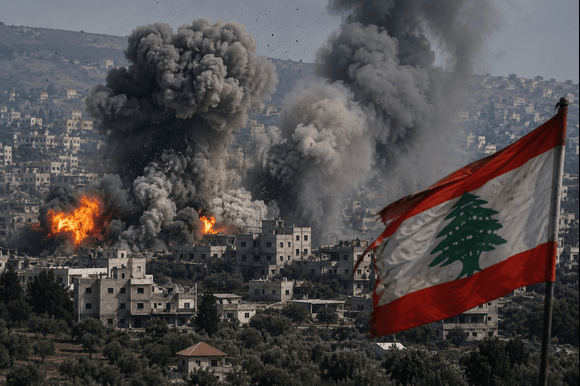
At least 18 people have been killed after Israeli forces launched a series of air strikes across southern Lebanon amid what officials and local sources described as intense fighting between Israeli troops and Hezbollah fighters.
The latest escalation marks one of the deadliest flare-ups in recent weeks and threatens to undermine broader diplomatic efforts aimed at stabilising the region following the recent ceasefire arrangement between the United States and Iran.
The Israeli military announced on Friday that it had carried out overnight attacks against multiple targets throughout southern Lebanon and indicated that operations were continuing. Military officials said the strikes were part of ongoing efforts against Hezbollah positions in the region.
Lebanon’s National News Agency (NNA) reported that at least 18 people were killed during the attacks, while additional casualties were feared as rescue teams continued assessing the aftermath of the bombardment.
At the same time, Hezbollah confirmed that fierce battles were taking place in southern Lebanon, describing the confrontations as some of the most intense since the recent reduction in hostilities elsewhere in the region.
According to Lebanese media reports, four Israeli soldiers, including a battalion commander, were killed during clashes with Hezbollah fighters. The reported military losses represent a significant blow for Israel’s forces operating in the area.
The renewed violence has already affected diplomatic initiatives intended to secure a more permanent peace agreement in the Middle East. Planned technical discussions between American and Iranian representatives in Switzerland have reportedly been delayed after Tehran declined to send its delegation while Israeli military operations inside Lebanon continue.
Iranian officials are said to have informed mediators that the continuation of Israeli attacks complicated efforts to move forward with negotiations aimed at permanently ending the wider conflict.
Israel has maintained that its military operations in southern Lebanon remain necessary despite international pressure. Israeli officials argue that Hezbollah continues to launch attacks into northern Israel and that military action is required to neutralise the threat posed by the Iran-backed armed group.
The deaths of Israeli soldiers sparked strong reactions from members of Israel’s governing coalition. National Security Minister Itamar Ben-Gvir responded on social media by declaring that “all of Lebanon must burn,” while Finance Minister Bezalel Smotrich called on Israel to “open the gates of hell” against Hezbollah and its supporters.
Their comments have drawn criticism from regional observers who warn that such rhetoric could further inflame tensions and complicate efforts to preserve fragile ceasefire arrangements.
Violence has continued across southern Lebanon throughout the week. On Thursday, Lebanon’s National News Agency reported that an Israeli drone strike targeted a vehicle near the town of Kfar Tebnit, killing two people. Another Israeli attack in the town of Zabadin reportedly killed at least one additional person.
Hezbollah claimed it had successfully repelled a four-day Israeli military push intended to advance deeper into Lebanese territory. In a statement, the group said its fighters used drones, rockets and artillery to target Israeli soldiers and armoured vehicles, preventing troops from moving towards Kfar Tebnit and surrounding areas.
The organisation portrayed the operation as evidence that it remains capable of resisting Israeli incursions despite months of conflict and sustained military pressure.
The latest confrontations come at a sensitive moment, with Israel facing growing international calls to halt military operations in Lebanon and withdraw remaining forces from occupied areas under provisions linked to the broader US-Iran ceasefire arrangement.
US President Donald Trump recently stated that Washington expected a “complete ceasefire on all fronts,” including between Israel and Hezbollah. In comments posted on social media, Trump urged all parties involved in regional conflicts to maintain their commitments and avoid actions that could jeopardise ongoing diplomatic efforts.
“We encourage everyone in the Middle East region to maintain their commitment to allowing our negotiations to beautifully unfold,” Trump wrote.
Meanwhile, Israel’s military published a map on Thursday detailing what it described as the current deployment of its forces inside southern Lebanon. The map indicated Israeli positions extending roughly 10 kilometres into Lebanese territory along what the military referred to as its “Yellow Line.”
Analysts have compared the framework to military control measures employed by Israel in other conflict zones, including parts of the Gaza Strip.
The map has generated controversy among legal experts because it appears to include not only sections of Lebanese land but also portions of Lebanon’s maritime territory. Maritime law specialists argue that any attempt to occupy or control these waters would potentially violate the 2022 maritime boundary agreement negotiated between Lebanon and Israel with US mediation.
Particularly significant is the inclusion of waters connected to Lebanon’s Qana gas field project. Exploration rights to the offshore energy resource were specifically guaranteed to Lebanon under the 2022 maritime agreement, making any military presence in the area highly sensitive.
Political pressure is also increasing inside Israel. Members of Prime Minister Benjamin Netanyahu’s ruling coalition have urged the government to adopt a tougher stance towards both Lebanon and international calls for restraint.
Moshe Saada, a lawmaker from Netanyahu’s Likud Party, told Reuters that Israel should not consider withdrawing from southern Lebanon under current circumstances.
“Prime Minister Netanyahu needs to tell Trump enough,” Saada said.
He argued that maintaining Israeli military positions was essential for national security and claimed that withdrawal would create what he described as an existential threat to Israel.
According to Saada, Israel should continue striking targets throughout Lebanon around the clock and with maximum force.
Reporting from Beirut, Al Jazeera correspondent Zeina Khodr noted that while the scale of Israeli bombardment has decreased compared with previous weeks, attacks have not stopped completely.
“There has been a reduction in violence in the sense that we are no longer seeing an intensive Israeli bombing campaign across southern Lebanon,” Khodr reported. “However, Israeli drone strikes have continued over recent days and have still resulted in casualties.”
Khodr also said Hezbollah believes recent diplomatic developments involving Iran have strengthened its position.
According to her analysis, the group views the US-Iran agreement as providing Tehran with additional leverage and believes this has improved Hezbollah’s ability to challenge Israeli military actions.
“Hezbollah has been responding to those strikes, sending a clear message that it is not going to accept a one-sided ceasefire,” she said.
She added that Israeli authorities themselves had acknowledged casualties among their troops following Hezbollah attacks in southern Lebanon and noted that the organisation remains firmly opposed to any attempts at disarmament.
“Hezbollah is telling the Lebanese government that it will not accept disarmament,” Khodr said.
Meanwhile, the United States Treasury Department announced a new package of sanctions targeting several Lebanese officials and business figures accused of supporting Hezbollah or maintaining links with networks already under American sanctions.
US officials said the measures were aimed at individuals allegedly obstructing Lebanon’s peace process and slowing efforts to reduce Hezbollah’s military influence.
The Treasury Department also imposed sanctions on additional individuals and organisations operating in Lebanon, Syria, Iraq and Oman. According to Washington, these entities were involved in fundraising activities and front-company operations that provided financial support to Hezbollah.
The conflict has had a devastating humanitarian impact on Lebanon. According to figures released by the Lebanese Ministry of Public Health, Israel’s military campaign has killed at least 3,912 people since March 2. The ministry said another 11,873 people have been wounded, while more than one million residents have been displaced from their homes as fighting continues across large parts of the country.
With military operations intensifying once again and diplomatic negotiations facing new obstacles, fears are growing that the fragile calm achieved in recent weeks could collapse, potentially drawing the region into another dangerous phase of conflict.