


United States President Donald Trump is expected to turn his attention toward North Korea’s nuclear programme after Washington successfully concluded a major agreement with Iran, according to South Korean President Lee Jae Myung.
Speaking during a news conference, Lee revealed that Trump made the remarks during a dinner meeting on the sidelines of the G7 summit on Friday. According to Lee, the US president indicated that resolving issues related to North Korea’s nuclear ambitions was becoming a priority following progress in negotiations with Tehran.
“President Trump told me that the time had come to pay attention to the North Korea issue,” Lee said, suggesting that Washington could soon renew diplomatic and strategic efforts aimed at addressing Pyongyang’s expanding nuclear arsenal.
The comments come at a time of growing concern among regional powers about North Korea’s advancing weapons programme and its increasingly close military ties with Russia.
Lee used the meeting to express concerns regarding the effectiveness of international sanctions imposed on North Korea. He argued that economic restrictions have failed to significantly weaken Pyongyang because of growing support from Moscow.
According to the South Korean leader, even limited assistance from Russia has helped North Korea withstand international pressure and continue developing its military capabilities.
“Even a small amount of assistance from Russia is of great help to North Korea,” Lee said.
The Korean Peninsula remains one of the world’s most heavily militarised regions. North and South Korea are technically still at war because the 1950-1953 Korean War ended with an armistice agreement rather than a formal peace treaty.
The two countries remain divided by the heavily fortified Demilitarized Zone (DMZ), which stretches across the peninsula and serves as one of the most closely guarded borders in the world.
North Korea conducted its first nuclear weapons test in 2006, marking a major turning point in regional security. Since then, the country has carried out multiple nuclear and ballistic missile tests and is widely believed to possess dozens of nuclear weapons.
In recent years, North Korean leader Kim Jong Un has sought to strengthen his country’s international standing through closer cooperation with key allies.
One of the most significant developments has been Pyongyang’s growing military partnership with Russia. North Korea has reportedly supplied troops, artillery shells and other military equipment to assist Moscow’s war effort in Ukraine, deepening ties between the two countries.
Kim has also strengthened relations with China, North Korea’s most important economic and political partner.
Recently, Chinese President Xi Jinping travelled to Pyongyang for high-level talks with Kim. The visit came shortly after Xi held consecutive summit meetings in Beijing with both Trump and Russian President Vladimir Putin, underscoring China’s central role in regional diplomacy.
Observers noted that official statements released by both North Korea and China following Xi’s visit made no mention of denuclearisation, a notable omission that many analysts interpreted as a sign of Beijing’s increasing acceptance of North Korea’s status as a nuclear-armed state.
The absence of references to dismantling Pyongyang’s nuclear programme was viewed by some experts as tacit recognition that denuclearisation is no longer considered an immediate or realistic objective by China.
North Korea itself has repeatedly insisted that its nuclear weapons programme is permanent and non-negotiable.
Since the collapse of the 2019 summit between Kim and Trump in Hanoi, North Korean officials have consistently described the country as an “irreversible” nuclear state.
The Hanoi meeting, which had been viewed as a potentially historic opportunity for a breakthrough, ended without an agreement after the two sides failed to bridge differences over sanctions relief and the extent of denuclearisation measures expected from Pyongyang.
Following that summit’s collapse, Kim accelerated efforts to expand the country’s strategic weapons capabilities.
He has repeatedly pledged to strengthen North Korea’s nuclear deterrent and recently unveiled a new facility dedicated to producing materials used in the development of nuclear bomb fuel.
The renewed focus on North Korea would represent a return to one of the defining foreign policy challenges of Trump’s first term in office.
During his previous presidency, Trump held three unprecedented meetings with Kim Jong Un in an effort to secure a comprehensive agreement on denuclearisation.
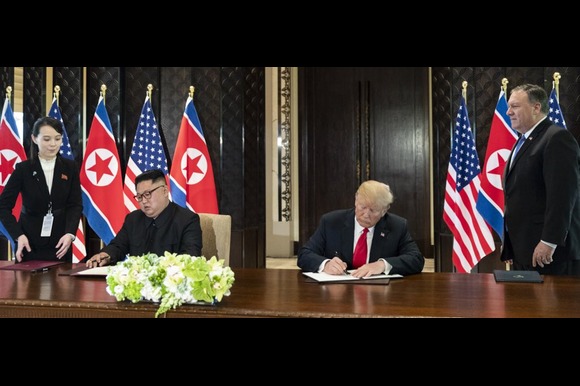
The first summit took place in Singapore in 2018 and was followed by meetings in Hanoi and at the Korean Demilitarized Zone. The encounters marked the first direct meetings between a sitting US president and a North Korean leader.
At one stage, Trump famously described his relationship with Kim in unusually personal terms, saying the two leaders had fallen “in love” after exchanging letters.
Despite the diplomatic spectacle and historic symbolism of the meetings, negotiations ultimately failed to produce a lasting agreement or meaningful reductions in North Korea’s nuclear arsenal.
In the years since leaving office and returning to the White House, Trump has continued signalling his willingness to engage directly with Kim.
During a tour of Asia last year, Trump stated that he was “100 percent” open to meeting the North Korean leader again if such a meeting could advance peace and stability in the region.
However, Pyongyang has not publicly responded to those overtures, and there has been no indication that North Korean officials are prepared to resume high-level negotiations with Washington.
Trump has also departed from decades of traditional US policy language regarding North Korea.
Rather than avoiding recognition of Pyongyang’s nuclear capabilities, he previously referred to North Korea as “sort of a nuclear power,” a remark that generated debate among diplomats and security experts concerned about the implications of such terminology.
Speculation about a possible diplomatic reopening intensified on Sunday when Trump posted an uncaptioned photograph of himself alongside Kim Jong Un.
The image, taken during their landmark 2018 summit in Singapore, appeared on Trump’s social media account without explanation.
Although the post contained no accompanying message, political analysts interpreted it as a possible signal that the US president remains interested in re-engaging with North Korea and reviving talks that have been stalled for years.
With tensions on the Korean Peninsula remaining high, North Korea continuing to expand its weapons programmes, and regional alliances shifting amid global geopolitical competition, Trump’s renewed focus on Pyongyang could once again place North Korea’s nuclear ambitions at the centre of international diplomacy.