


Moscow/Yekaterinburg, June 2026 — For generations, Russians viewed the vast territory beyond the Ural Mountains as a natural shield against foreign threats. During both Napoleon’s invasion of 1812 and Nazi Germany’s advance during World War II, factories, civilians, and critical infrastructure were evacuated eastward with the belief that the region was safely beyond the reach of enemy forces.
That long-held sense of security is now being challenged by modern warfare.
In late April, Ukrainian drones struck targets in Yekaterinburg, the largest city in Russia’s Ural region and a major industrial hub located more than 1,800 kilometres from the Ukrainian border. The attack underscored Kyiv’s growing ability to project force deep inside Russian territory, far beyond the traditional front lines of the conflict.
According to reports, Ukrainian forces targeted facilities linked to the production of components used in Russian air defence systems. While the full extent of the damage remains unclear, the strikes have had a noticeable impact on daily life in the region. Since the first attack, operations at Yekaterinburg’s airport have been suspended multiple times due to security concerns, disrupting travel and commercial activity.
Residents say the effects of the war are increasingly being felt far from the battlefield. Concerns over inflation, fuel shortages, and economic uncertainty have intensified as repeated Ukrainian strikes target oil refineries, fuel depots, and strategic infrastructure across Russia.
Local business owner Anatoly, a 45-year-old resident of Yekaterinburg, described growing anxiety among ordinary citizens. He said rising prices, business closures, and long queues at petrol stations have become common sights. Authorities and suppliers have reportedly restricted the sale of fuel in portable containers amid fears of hoarding and resale at inflated prices.
According to him, many residents have begun stockpiling food and essential goods in anticipation of further disruptions. While expressing opposition to the war, he suggested that many people in his social circle viewed the consequences now being felt inside Russia as an inevitable result of the conflict.
The growing sense of unease comes as Russia’s military campaign enters a difficult phase. Moscow’s latest summer offensive, intended to secure additional territory in eastern and southern Ukraine, has failed to achieve a decisive breakthrough despite months of fighting.
Russian forces continue to make incremental gains in parts of the Donbas region, but analysts say the pace of advance has slowed significantly. At the same time, Ukrainian drone operations have increasingly disrupted supply routes and military logistics behind the front lines.
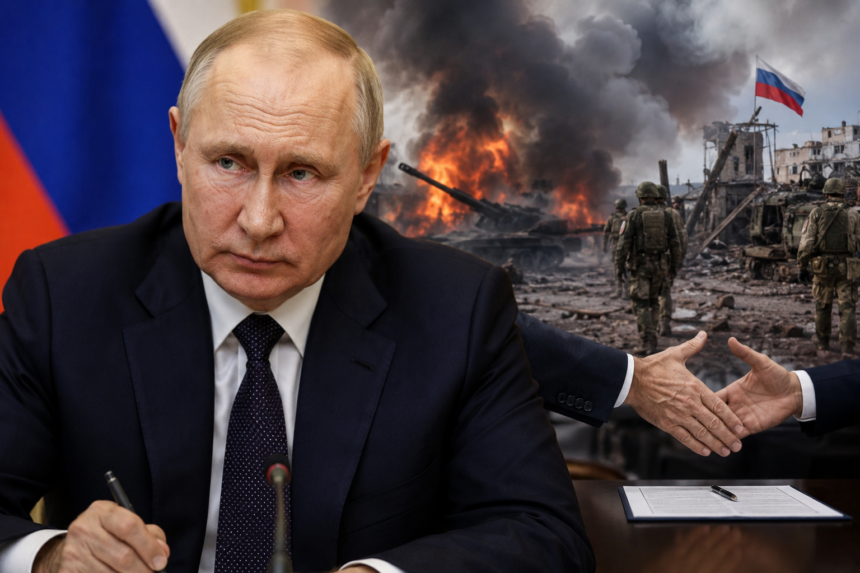
Against this backdrop, Russian President Vladimir Putin has renewed calls for peace negotiations with Ukraine. Speaking this week, Putin said Moscow remains prepared to resume discussions based on proposals developed during earlier talks held in Istanbul in 2022.
The Russian leader’s comments came after diplomatic efforts were interrupted by broader regional tensions linked to the conflict involving Iran and Western powers. Moscow has repeatedly stated that it remains open to negotiations, though many observers believe the Kremlin’s proposals remain unacceptable to Kyiv.
Ukrainian officials have consistently rejected several key Russian demands, arguing that they would effectively reward aggression and compromise the country’s sovereignty. Analysts suggest Moscow may be seeking to buy time while addressing mounting military and economic pressures at home.
Nikolay Mitrokhin, a researcher at Germany’s Bremen University, argues that the Kremlin is attempting to navigate an increasingly difficult strategic situation. According to his assessment, Ukraine now has an opportunity to regain momentum on the battlefield after Russia’s advance stalled following years of attritional warfare.
Meanwhile, organisations that assist Russian soldiers seeking to avoid military service report an increase in inquiries. Ivan Chuvilyaev, a representative of a group that helps Russian servicemen leave the military, said requests for assistance tend to rise whenever offensive operations fail to achieve expected results.
The debate over potential peace negotiations remains closely tied to Moscow’s long-standing demands regarding Ukraine’s future status.
Pro-Kremlin political analyst Sergey Markov recently outlined conditions that Russian officials have repeatedly promoted since the beginning of the conflict. These include demands for Ukraine’s demilitarisation, restrictions on its armed forces, guarantees of neutrality, and a permanent commitment not to join NATO.
Russian officials have also argued that Ukraine should provide greater protections for Russian-language speakers and accept limitations on future military capabilities, including restrictions on nuclear development.
Additionally, Moscow continues to insist that Ukraine withdraw from parts of the Donbas region claimed by Russia and formally recognise Crimea as Russian territory. Kyiv has consistently rejected these conditions, arguing that they violate international law and Ukraine’s territorial integrity.
Questions regarding political legitimacy also remain a major obstacle. Russian officials have repeatedly claimed that Ukrainian President Volodymyr Zelenskyy lacks a renewed electoral mandate because elections have not been held during wartime. Ukrainian authorities counter that martial law legally prevents national elections while active hostilities continue.
While diplomatic discussions remain uncertain, military realities on the ground continue to evolve. Analysts note that although Russia is still advancing in some areas of Donbas, the gains are limited and increasingly costly.
Mitrokhin argues that battlefield successes alone may not compensate for growing vulnerabilities elsewhere. Ukrainian drone strikes have expanded far beyond border regions and are increasingly targeting logistics networks, industrial facilities, and transportation infrastructure that support Russia’s war effort.
If these disruptions continue at their current pace, some experts believe Russia may face significant challenges maintaining operational momentum. Supply lines have become more exposed, while repeated attacks on infrastructure have increased pressure on regional economies.
Others suggest that Putin’s renewed interest in negotiations reflects broader domestic concerns rather than purely military calculations.
Sergey Biziykin, an exiled Russian opposition activist, believes public attitudes toward the conflict have changed considerably since the early months of the war. According to him, many Russians who initially supported the campaign expected a rapid victory and have become increasingly frustrated as the conflict drags on.
He argues that while public dissatisfaction has grown, many citizens remain resigned to enduring hardship. Corruption, economic instability, and declining living standards have become familiar challenges, making large-scale public mobilisation against the war unlikely despite mounting frustrations.
The effects of Ukrainian drone operations are also being felt in regions surrounding Moscow.
Some residents of the capital have relocated temporarily to rural areas in search of greater security. However, even communities hundreds of kilometres from major urban centres are no longer insulated from the conflict.
Arseny, a Moscow-based copywriter who moved to a countryside property in the Yaroslav region, said life outside the capital feels calmer but not entirely safe. While he described cleaner air and fewer disruptions compared with Moscow, he noted that drone activity and air defence operations can still be heard from considerable distances.
According to his account, explosions linked to interceptions of Ukrainian drones have occasionally been powerful enough to shake homes in surrounding villages, reinforcing the sense that the conflict now reaches deep into Russian territory.
Economic analysts say the cumulative effect of these attacks is contributing to broader structural weaknesses within Russia’s economy.
A report released by Swedish economic research institutions earlier this month concluded that while Russia’s economy has not collapsed under the pressure of sanctions and war-related spending, key foundations have weakened significantly. Researchers pointed to growing logistical challenges, labour shortages, rising costs, and increasing dependence on military production as signs of long-term strain.
The report argued that Russia is entering a phase where the economic consequences of prolonged conflict are becoming more visible, even if headline indicators remain relatively stable.
In Ukraine, reactions to Russia’s difficulties are often shaped by years of living under constant threat.
Many Ukrainians view the disruption inside Russia as a consequence of the destruction inflicted on Ukrainian cities since the invasion began. Residents of Kyiv and other frequently targeted areas note that Russian missile and drone attacks have caused far greater devastation over a much longer period.
Financial consultant Hannah Onopriyenko, whose neighbourhood in central Kyiv has repeatedly come under attack, said she feels little sympathy for the inconveniences now being experienced by Russians. Recent strikes in her district killed several people, injured dozens more, and damaged civilian infrastructure, including commercial centres and transport facilities.
At the same time, she acknowledged that the scale of disruption inside Russia remains far below what many Ukrainians have endured throughout more than four years of war. For countless residents across Ukraine, daily life continues to be shaped by air raid sirens, damaged infrastructure, and the constant threat of renewed attacks, realities that remain far more severe than the hardships currently being reported across most of Russia.