

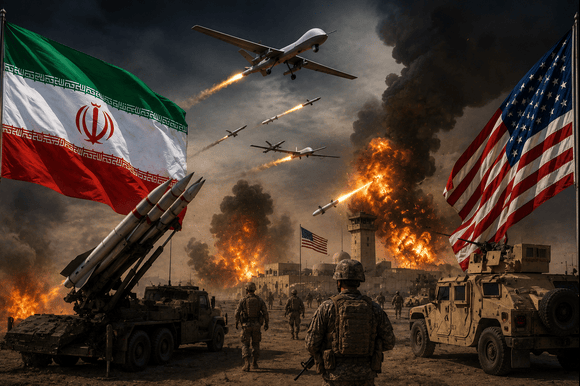
Iran says it has launched a series of drone attacks targeting US military facilities and bases across the Middle East, marking a significant escalation in its confrontation with Washington following the 13th consecutive night of American military strikes against Iranian targets.
The latest exchange of attacks comes amid rapidly rising tensions between the two countries, raising fresh concerns over regional stability, maritime security and the possibility of a broader conflict involving several Middle Eastern states.
According to Iranian officials, the drone strikes were carried out in retaliation for ongoing US military operations that have continued for nearly two weeks.
Explosions were reported across several parts of Iran overnight, including areas along the country’s Gulf coastline as well as western, northern and central provinces.
Iranian state media reported that at least four people were killed and five others injured during an attack in the country’s south-western region, although further details about the casualties have not yet been released.
Later, Iran announced that it had expanded its retaliation by targeting US military installations in Kuwait, one of Washington’s key regional allies.
Shortly afterwards, air raid sirens were activated in Bahrain, while warning alarms were also reported in Jordan as regional governments monitored the evolving security situation.
Authorities in Iraq temporarily suspended flights at Erbil International Airport after reports that a drone had crashed near the facility. Airport operations later resumed once security assessments were completed.
The military escalation coincides with a growing diplomatic dispute over US plans to use frozen Iranian assets to compensate for damages caused during the conflict.
On Thursday, US President Donald Trump announced that compensation for damage sustained by commercial ships and cargo passing through the strategically important Strait of Hormuz would be paid using Iranian funds currently frozen under US control.
Posting on his Truth Social platform, Trump argued that Iran should bear the financial responsibility for losses resulting from attacks on international shipping.
“These damages may be very substantial but, nevertheless, this is the fair and equitable thing to do,” Trump wrote.
The proposal drew an immediate and strongly worded response from Tehran.
Iranian Foreign Minister Abbas Araghchi condemned the idea, warning that confiscating another country’s frozen assets to satisfy unrelated future claims would establish a dangerous international precedent.
He described the proposal as highly provocative and warned that its consequences could extend well beyond the current conflict.
“Seizing another country’s assets to pay for unrelated future claims is an incendiary precedent,” Araghchi said.
“Ensuing chaos will not be pretty or peaceful,” he added.
The latest confrontation represents a dramatic reversal from the diplomatic breakthrough reached only weeks earlier.
In June, the United States and Iran agreed to a 14-point Memorandum of Understanding (MoU) designed to halt military operations, reopen the Strait of Hormuz and establish a framework for ending the conflict within a 60-day period.
The agreement included commitments by both governments to de-escalate hostilities and restore safe navigation through one of the world’s busiest maritime trade routes.
However, the ceasefire quickly unraveled.
Only three weeks after the memorandum was signed, President Trump declared that the agreement was effectively over following renewed Iranian attacks on commercial shipping in the Strait of Hormuz and subsequent US military strikes against Iranian targets.
One of the most closely watched provisions of the agreement was Point 11 of the memorandum.
That section specifically stated that the United States would make fully available for use the frozen or otherwise restricted funds and assets belonging to the Islamic Republic of Iran.
Trump’s latest proposal to instead use those assets to compensate shipping losses appears to represent a significant departure from the commitments outlined in the original agreement.
The renewed fighting has also intensified concerns over the security of global energy supplies.
As the United States seeks to strengthen control over maritime traffic in the Strait of Hormuz, international attention has increasingly shifted toward the Red Sea, where Yemen’s Iran-backed Houthi movement continues to threaten commercial shipping.
Analysts warn that simultaneous disruptions in both waterways could have serious consequences for global trade and energy markets.
The uncertainty has already pushed international crude oil prices above $100 (£74.96) per barrel, marking their highest level since May as traders react to the growing risks facing one of the world’s most important oil transport corridors.
President Trump also issued a separate warning directed at the Houthi movement.
He pledged what he described as “major military punishment” against Iran should Tehran continue supporting Houthi attacks on commercial vessels operating in regional waters.
Later in the day, Trump told the Axios news website that his administration was actively considering a substantial expansion of military operations against Iran.
He suggested that future American strikes could be “bigger than ever before” if Iranian attacks continued.
Relations between Washington and Tehran have deteriorated rapidly since the beginning of July, with both countries exchanging repeated military actions across multiple fronts.
On Thursday night, the US military confirmed that it had conducted another wave of strikes intended to weaken Iran’s ability to threaten civilian shipping and regional maritime security.
US Central Command (CENTCOM) said the operation targeted a broad range of Iranian military infrastructure.
According to the command, the strikes focused on Iranian military command centres, drone storage facilities, communication networks, coastal surveillance installations and maritime capabilities believed to support operations in the Gulf region.
Iranian military officials responded by claiming responsibility for attacks on US military bases in Kuwait.
Meanwhile, Bahrain’s Interior Ministry confirmed that air raid sirens had been activated as a precautionary measure following reports of incoming threats.
Iranian state media also reported that warning alarms had sounded in neighbouring Jordan as regional security forces remained on high alert.
Elsewhere, both AFP and Reuters reported that a drone crashed near Iraq’s Erbil International Airport, prompting authorities to temporarily suspend flight operations while security teams investigated the incident.
Airport officials later confirmed that flights had resumed after the area was declared safe.
The latest exchange of strikes highlights the rapidly expanding scope of the confrontation between Iran and the United States, with military operations now affecting multiple countries across the Middle East.
As diplomatic efforts continue to collapse and both sides signal their willingness to intensify military action, regional governments and international observers are increasingly warning that the conflict risks developing into a much wider crisis with significant consequences for global security, international trade and energy markets.