

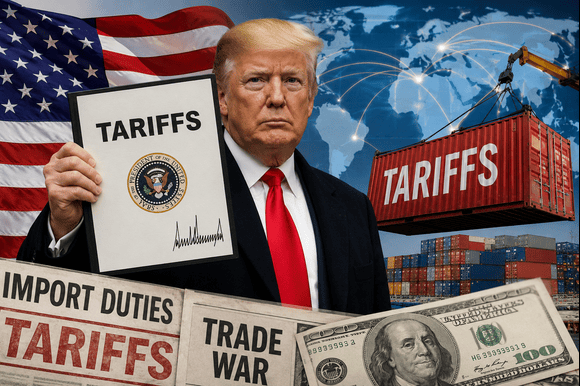
The United States has introduced a fresh round of tariffs on 60 of its largest trading partners, marking the latest escalation in the global trade campaign relaunched by President Donald Trump after returning to office last year.
The new measures affect major economies including the United Kingdom, China, the European Union, Japan, Australia, Brazil and dozens of other nations. Under the policy, affected countries will face tariffs ranging from 10% to 12.5% on virtually all goods exported to the United States, covering almost the entirety of American imports.
The tariffs replace a temporary 10% levy that expired on Friday and are being introduced under a new legal framework centred on allegations that trading partners have failed to adequately combat forced labour within their supply chains.
US Trade Representative Jamieson Greer defended the decision, saying the action is intended to address both human rights concerns and unfair trade practices.
“These countries have not done enough to tackle forced labour. Today’s action will begin to correct what is both a human rights abuse and a distortive trade practice to improve the welfare of workers everywhere,” Greer said.
According to the Office of the US Trade Representative, the new tariff structure applies to the United States’ top 60 trading partners, accounting for approximately 99.4% of all US imports.
However, several trade experts have questioned the administration’s stated justification.
Caroline Freund, Dean of the UC San Diego School of Global Policy and Strategy and a leading US trade economist, argued that the forced labour rationale is primarily a legal mechanism rather than the administration’s true objective.
Speaking to the BBC’s Today programme, Freund said the White House appeared to be searching for a legally sustainable basis to preserve tariffs after earlier court rulings invalidated previous measures.
“I think they were looking for a legal reason to put the tariffs in,” Freund said. “Their goals, and Greer has been very clear about this, as has President Trump, are about reducing the trade deficit and rebuilding US manufacturing. It is not really about forced labour.”
Her comments come after the US Supreme Court ruled earlier this year that many tariffs imposed under emergency executive powers had been enacted unlawfully.
The ruling struck down a series of sweeping global tariffs introduced by Trump during his second presidency, forcing the administration to seek alternative legal avenues to continue its trade agenda.
The latest tariff system closely mirrors the temporary 10% universal levy that had been in place until Friday, although countries will now be divided into two categories.
Trading partners that have committed to adopting and effectively enforcing bans on imports produced through forced labour will face a 10% tariff.
Countries that Washington believes have failed to meet those standards will be subject to the higher 12.5% rate, according to the Office of the US Trade Representative.
Economic analysts have warned that the new duties could increase costs for American businesses importing goods as well as consumers purchasing foreign products, although the overall impact may be moderated because numerous products remain exempt from the measures.
Wendy Cutler, vice-president of the Asia Society Policy Institute and an expert on international economic security, said many governments would likely be disappointed by Washington’s latest move.
She predicted that affected countries would increasingly seek to diversify their trade relationships and reduce their reliance on the US market by negotiating deeper commercial ties with other economies.
Businesses in the United Kingdom have also expressed concern following the announcement.
William Bain, Head of Trade Policy at the British Chambers of Commerce (BCC), said Britain has effectively lost the competitive advantage it previously enjoyed over European Union exporters.
While the European Union has secured what Bain described as an “all-inclusive” 10% tariff arrangement, UK exporters will continue facing a universal 10% tariff in addition to any existing duties imposed on individual products.
“There will certainly be concerns across the business community about what more the UK government needs to do in order to receive the same treatment that has been granted to the European Union,” Bain said.
David Henig, Director of UK Trade Policy at the European Centre for International Political Economy, also acknowledged that Britain’s position had weakened relative to its European neighbours.
Speaking to BBC Radio, Henig noted that while the UK had slipped backwards under the new system, uncertainty remains a defining feature of Trump’s trade policy.
“This is President Trump,” Henig said. “Anything could change tomorrow or the day after. I don’t think many businesses will be making major changes to their plans based solely on today’s announcement.”
The latest tariffs represent another chapter in Trump’s evolving trade strategy.
In April 2025, the president unveiled his so-called “Liberation Day” tariffs, imposing duties of up to 50% on imports from countries around the world in an effort to address what he described as longstanding unfair trade practices against the United States.
Those sweeping tariffs were struck down by the US Supreme Court in February 2026 after the court ruled that the president had exceeded his legal authority, resulting in tens of billions of dollars in tariff refunds.
Following the court decision, the White House introduced a temporary universal 10% tariff while developing a replacement policy capable of surviving legal scrutiny.
That interim tariff expired on Friday and has now officially been replaced by the new 10% to 12.5% system.
Under the revised framework, countries demonstrating effective enforcement against forced labour imports qualify for the lower tariff band, while those deemed non-compliant face the higher rate.
The UK government insisted that British companies would see no immediate change in the tariff rates they currently pay.
A government spokesperson said Britain remains committed to preventing forced labour within international supply chains.
“We take forced labour very seriously to ensure that UK businesses are not complicit in such practices through global supply chains,” the spokesperson said.
British whisky producers also avoided new trade barriers after President Trump previously agreed to exempt whisky exports during King Charles III and Queen Camilla’s state visit to the United States.
International reaction to Washington’s latest tariff package has been largely critical.
Brazil’s government described the new 12.5% tariff imposed on its exports as “unjustified” and warned that the decision could negatively affect bilateral trade.
Japan also expressed disappointment, with government officials saying they regretted Washington’s decision to introduce additional import duties.
Australian Trade Minister Don Farrell similarly condemned the measures, calling them “completely unjustified” and arguing they undermine the principles of open international trade.
China, one of the primary targets of previous US tariff campaigns, rejected the allegations underpinning the new policy.
Beijing has consistently denied accusations that forced labour exists within its manufacturing sector, particularly in the Xinjiang region, where international human rights organisations have documented allegations involving Muslim ethnic minorities.
Chinese Foreign Ministry spokesperson Mao Ning dismissed the US justification.
“There is no so-called forced labour in China,” Mao said. “We oppose using this issue as an excuse for political manipulation and unilateral tariff measures.”
Human rights organisations, however, continue to maintain that forced labour remains a serious concern in Xinjiang and have urged governments and multinational companies to strengthen oversight of supply chains connected to the region.
Tariffs have remained one of President Trump’s signature economic policies throughout both of his administrations.
He has repeatedly argued that import duties protect American industries, reduce trade deficits and encourage companies to relocate manufacturing back to the United States.
Beyond their economic role, Trump has frequently used tariffs as a diplomatic tool to pressure foreign governments on issues extending beyond trade, including immigration and border security, particularly in negotiations with Mexico.
The administration has also maintained tariffs on countries including Brazil and Canada, while the tariff dispute between Washington and Beijing remains temporarily paused following months of reciprocal trade measures.
Looking ahead, the White House could introduce additional tariffs in the coming months.
US authorities are currently investigating 16 countries, representing the overwhelming majority of American imports, over allegations of manufacturing overcapacity and other trade practices that Washington claims distort global markets.
The outcome of those investigations could lead to another round of import duties, signalling that President Trump’s aggressive trade strategy remains central to his broader economic agenda.