


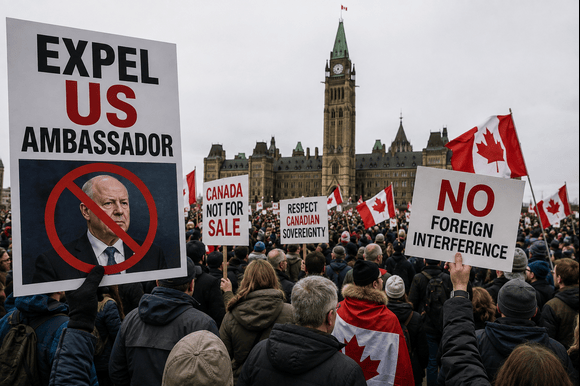
Thousands of Canadians have backed a parliamentary petition calling for the expulsion of US Ambassador to Canada Pete Hoekstra, demanding that Ottawa declare him “persona non grata” and order him to leave the country.
The campaign, which has attracted nearly 30,000 signatures, reflects growing public frustration over the state of Canada-US relations and increasing criticism of the Trump administration’s policies towards its northern neighbour.
Those supporting the petition accuse Hoekstra of going beyond the traditional role of a foreign ambassador by commenting on Canadian political affairs and intervening in sensitive domestic debates.
The demand for his removal comes at a time when relations between Ottawa and Washington have been strained by disputes over tariffs, trade, Canadian sovereignty and the future direction of the bilateral relationship.
Supporters of the campaign argue that the US ambassador’s public statements have crossed a diplomatic line and that Canada should respond firmly when foreign representatives are perceived to be interfering in domestic political matters.
The petition calls on the Canadian government to formally designate Hoekstra persona non grata, a diplomatic measure that would effectively require the ambassador to leave Canada.
However, the growing petition does not automatically mean that Hoekstra will be expelled.
Under Canada’s parliamentary petition system, a petition can generate an official government response, but the government is not legally required to adopt the action requested by its signatories.
The final decision would remain with the Canadian government, which would have to consider the potential diplomatic consequences of removing Washington’s ambassador.
Growing Anger Over US Policies
The campaign against Hoekstra has emerged amid increasingly difficult relations between Canada and the United States.
For decades, the two countries have maintained one of the world’s closest bilateral relationships, supported by extensive trade, shared security interests and strong political and cultural ties.
Canada and the US share the world’s longest international border, while their economies are deeply interconnected.
Millions of people and billions of dollars in goods and services move between the two countries every year.
Despite those close ties, relations have become considerably more complicated amid disagreements over American tariffs and other policies introduced by the Trump administration.
Canadian political leaders have repeatedly criticised US trade measures and defended the country’s economic independence.
The disputes have also triggered a wider public debate in Canada about its relationship with the United States.
Some Canadians have called for greater economic diversification and reduced dependence on American goods and markets.
Others have responded to US policies by encouraging consumers to purchase Canadian products and reconsider travel to the United States.
Within this environment, Hoekstra’s public statements have received heightened attention.
Critics argue that his comments have contributed to political tensions rather than helping to reduce them.
Hoekstra Faces Criticism Over Diplomatic Conduct
The central issue behind the petition is the allegation that Hoekstra has interfered in Canadian domestic politics.
Opponents argue that a foreign ambassador should represent his government’s interests while respecting the political independence of the host country.
They say Hoekstra’s comments on Canadian political issues have gone beyond what they consider appropriate diplomatic engagement.
The ambassador, however, has defended his role.
US diplomats regularly meet politicians, business leaders, journalists and members of the public, and ambassadors are expected to communicate their governments’ positions on issues affecting bilateral relations.
From Washington’s perspective, publicly discussing trade, security and other bilateral issues is part of normal diplomatic activity.
The dispute therefore reflects a broader disagreement over where diplomatic engagement ends and political interference begins.
That distinction has become increasingly difficult to maintain as Canada-US relations have grown more politically charged.
What Does ‘Persona Non Grata’ Mean?
Declaring a foreign diplomat persona non grata is one of the strongest diplomatic measures available to a government.
The term essentially means that the host country no longer considers the diplomat acceptable.
Once a diplomat is declared persona non grata, the sending government is normally expected to recall the individual.
The measure can be used when a diplomat is accused of unacceptable conduct or when relations between two countries have deteriorated significantly.
Expelling a US ambassador would therefore carry considerable diplomatic weight.
Canada and the United States are not only neighbours but also close economic and military partners.
They cooperate through organisations and arrangements involving continental defence, intelligence, border security and international security.
An ambassadorial expulsion could consequently create new difficulties across several areas of cooperation.
Possible Response From Washington
If Ottawa were to remove Hoekstra, Washington could respond with its own diplomatic measures.
The United States could potentially recall Canada’s ambassador or take another retaliatory step, although the precise response would depend on the circumstances.
Such an escalation could further complicate already difficult negotiations between the two countries.
Trade and tariff disputes are particularly sensitive because of the enormous volume of economic activity that crosses the Canada-US border.
Businesses in both countries depend heavily on predictable trade relations.
A prolonged diplomatic confrontation could create additional uncertainty for companies, investors and workers.
Other areas that could be affected include border management, energy cooperation, defence, immigration, law enforcement and Arctic security.
Public Pressure on Prime Minister Mark Carney
The petition presents a challenge for Prime Minister Mark Carney’s government.
Canadian authorities face pressure to respond to citizens who believe the United States has taken an increasingly aggressive approach towards Canada.
At the same time, Ottawa has strong practical reasons for maintaining a functioning relationship with Washington.
The US remains Canada’s largest trading partner and one of its most important security allies.
Canada’s economy is heavily integrated with the American economy, while cooperation between the two countries remains essential in areas such as defence and continental security.
Expelling an ambassador could therefore satisfy some domestic critics while potentially creating a new diplomatic crisis.
The Canadian government may instead choose to acknowledge the concerns raised by petitioners while avoiding an immediate decision to expel Hoekstra.
Officials could also raise concerns privately with Washington or issue a public warning regarding diplomatic conduct.
The Petition Reflects Wider Canadian Concerns
The campaign to remove Hoekstra is larger than a dispute involving one ambassador.
It has emerged as part of a wider conversation about Canada’s sovereignty and its long-standing dependence on the United States.
The country’s close economic relationship with Washington has historically been considered one of Canada’s greatest strategic advantages.
However, recent tensions have encouraged some Canadians to question whether that dependence creates vulnerabilities.
Political leaders and businesses have increasingly discussed the need to diversify Canada’s international trade relationships.
The government has also faced public pressure to defend Canadian interests more aggressively when dealing with Washington.
The ambassador controversy has consequently become another symbol of the changing relationship between the two neighbours.
Could Relations Deteriorate Further?
The future of the petition will depend largely on whether it continues to gain public and political support.
Nearly 30,000 signatures demonstrate that the campaign has attracted considerable attention, but it remains unclear whether the Canadian government will take the exceptional step of declaring Hoekstra persona non grata.
A decision to expel him would represent a major escalation.
It could encourage further diplomatic retaliation from Washington and make negotiations on trade and other issues more difficult.
On the other hand, taking no action could frustrate Canadians who believe the ambassador has crossed diplomatic boundaries.
The government must therefore balance domestic political pressure with the country’s broader economic and security interests.
A Critical Moment for Canada-US Relations
The controversy comes at a particularly sensitive moment for the Canada-US relationship.
Despite recent disagreements, the two countries remain deeply connected through trade, investment, defence, energy, tourism and family ties.
The relationship has survived numerous political disputes in the past, but the current tensions have generated unusually strong public reactions in Canada.
The demand for Hoekstra’s expulsion illustrates how disagreements that were once primarily handled through diplomatic channels are increasingly becoming domestic political issues.
For supporters of the petition, the ambassador’s removal would send a message that Canada will not tolerate what they regard as foreign interference.
For Washington, however, an expulsion would likely be interpreted as a serious diplomatic rebuke.
The issue could therefore become an important test of how both governments manage disagreements while attempting to preserve essential areas of cooperation.
For now, the petition has succeeded in drawing public attention to the ambassador and the broader state of Canada-US relations.
Whether it results in actual diplomatic action remains uncertain.
What is clear is that growing public anger over American policies has added another layer of complexity to an already strained relationship.
As the petition process moves forward, Prime Minister Mark Carney’s government will face the difficult task of balancing demands to defend Canadian sovereignty with the economic and strategic realities of maintaining close relations with the United States.
The outcome could provide an important indication of how Ottawa intends to deal with Washington during a period of heightened political, economic and diplomatic uncertainty.