

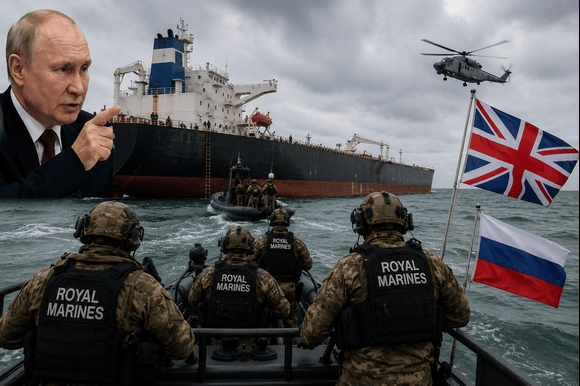
The UK government has defended its decision to seize a Russian-linked “shadow fleet” oil tanker in the English Channel after Russian President Vladimir Putin warned that Moscow could retaliate against Western countries for what he described as the unlawful seizure of Russian vessels.
The vessel, the Smyrtos, was intercepted and boarded by Royal Marines Commandos during an unprecedented operation aimed at disrupting a tanker accused of transporting sanctioned Russian oil.
Following the operation, the vessel was taken to an anchorage off Weymouth.
The incident has now triggered a sharp diplomatic response from Moscow, with Putin accusing Western nations of engaging in what he described as “piracy and banditry” and warning that Russia would respond if similar actions continued.
The captain of the Smyrtos, Ajay Pant, has been charged with violating Russian sanctions. He is accused of directly or indirectly supplying or delivering prohibited Russian oil.
The case has emerged as Western governments intensify efforts to disrupt Russia’s so-called shadow fleet, a network of ageing or obscurely owned vessels that Western officials say are being used to circumvent international sanctions imposed following Russia’s full-scale invasion of Ukraine.
Putin Warns of Russian Retaliation
Putin issued his warning on Wednesday while overseeing Russian naval exercises in the Pacific Ocean.
Addressing Russian sailors, the president criticised Western countries for what he described as attempts to seize Russian vessels.
He accused Western governments of acting unlawfully and warned that Moscow could retaliate against countries involved in such operations.
“If these plans are put into practice, we will have to respond in kind,” Putin said.
He then suggested that any potential Russian response would not necessarily take place in the same waters where Western countries were conducting operations.
“And not necessarily in the waters where raids on our ships and vessels are planned, but wherever we deem it necessary and appropriate, anywhere,” he warned.
The comments represent one of the strongest warnings from Moscow over the growing Western campaign against Russia’s shadow fleet.
The threat comes as European countries increase efforts to identify, monitor, board and sanction vessels suspected of helping Russia bypass restrictions on its oil exports.
Russian Pacific Fleet Commander Accuses Britain and France
Viktor Liina, commander of Russia’s Pacific Fleet, also criticised Western governments during the naval exercises.
Liina accused countries including Britain and France of maintaining their own versions of what Russia considers a “shadow fleet”.
He claimed Russia possesses the capability to inspect and detain vessels belonging to countries Moscow considers unfriendly.
“We have the capacity to inspect and detain vessels of unfriendly states and their shadow fleets, and interagency cooperation is in place, ready to begin addressing these challenges,” Liina said.
His comments underline the possibility that the dispute could develop into a broader confrontation over commercial shipping and maritime enforcement.
Western governments, however, reject comparisons between their actions and Russia’s alleged use of shadow fleet vessels.
The UK says its boarding of the Smyrtos was conducted under established legal procedures and was intended to enforce sanctions rather than interfere with legitimate international shipping.
UK Insists Operation Was Legal
In response to Putin’s remarks, the British government defended the operation and rejected accusations that the boarding amounted to piracy.
A UK government spokesperson said British armed forces and law-enforcement personnel had boarded the Smyrtos “in full accordance with international law”.
The government said the operation was part of a broader strategy designed to disrupt and deter shadow fleet vessels and prevent them from supporting Russia’s war effort in Ukraine.
“The UK is disrupting and deterring shadow fleet vessels and their harmful maritime activity which is fuelling Russia’s war with Ukraine,” the spokesperson said.
The British government also drew a distinction between the vessels targeted by its enforcement campaign and ships operated by the UK itself.
“UK armed forces and commercial vessels operate firmly in line with international maritime law,” the spokesperson said.
The statement was issued in response to Russian claims that Western nations were themselves engaging in unlawful maritime activity.
The UK government maintains that its actions are intended to enforce sanctions and protect the integrity of international restrictions imposed on Russian oil exports. The seizure of the Smyrtos represents a significant escalation in Britain’s efforts to disrupt Russia’s shadow fleet.
Royal Marines Commandos intercepted and boarded the tanker in the English Channel in June, marking the first operation of its kind by British forces.
The vessel was subsequently moved to an anchorage near Weymouth while authorities began legal proceedings.
The captain, Ajay Pant, faces allegations relating to the transportation of prohibited Russian oil.
The case highlights the increasingly direct measures being taken by Western countries against individual ships suspected of helping Moscow circumvent sanctions.
For years, Western governments have relied heavily on financial restrictions, export controls and sanctions against companies and individuals linked to Russia’s energy sector.
More recently, the focus has increasingly shifted towards the vessels themselves.
The aim is to make it harder for Russia to transport oil through alternative networks that operate outside the traditional Western-controlled shipping and insurance system.
What Is Russia’s Shadow Fleet?
The term “shadow fleet” is used by Western governments to describe a large network of tankers that are believed to be involved in transporting Russian oil while attempting to avoid sanctions.
These ships are often older vessels and can have complicated ownership structures.
Some operate under flags from countries with limited links to Russia, while others use different insurance arrangements or change ownership and registration details.
Western governments argue that these methods allow Russian oil to continue reaching international markets despite restrictions.
The UK Ministry of Defence estimates that Russia’s shadow fleet contains more than 700 vessels.
According to the ministry, these ships transport around 75% of Russia’s sanctioned oil.
British officials describe the oil trade as a critical source of revenue for the Kremlin and argue that disrupting the shadow fleet can reduce the money available to support Russia’s war in Ukraine.
The British Ministry of Defence has described the trade as a “critical lifeline for the Kremlin” because of its importance in financing the Russian economy and sustaining Moscow’s military campaign.
Moscow Rejects Western Sanctions Campaign
Russia has repeatedly rejected Western sanctions and accused European countries and the United States of attempting to damage its economy through restrictions on energy exports.
Moscow argues that many of the measures imposed on Russian shipping and oil exports are politically motivated and violate the rights of legitimate commercial operators.
Putin raised similar objections during his comments to Russian naval personnel.
He specifically criticised the European Union, accusing member states of violating international maritime law by attempting to restrict the movement of vessels associated with Russian economic operators.
The European Union has not accepted Russia’s characterization of its sanctions policy.
The BBC has sought a response from the EU regarding Putin’s latest accusations.
The disagreement reflects a much wider confrontation between Moscow and Western governments over the legal and economic consequences of Russia’s invasion of Ukraine.
EU Intensifies Pressure on Shadow Fleet
The British seizure of the Smyrtos comes as the European Union is also increasing pressure on Russia’s shadow fleet.
Western countries began imposing extensive sanctions on Russian energy exports after Moscow launched its full-scale invasion of Ukraine in 2022.
The restrictions were designed to reduce the revenues Russia receives from selling oil and other energy products.
However, Moscow has been accused of finding ways around the restrictions.
One of the most important methods has involved using ageing tankers with complicated ownership structures, limited transparency and alternative insurance arrangements.
These vessels have become a central part of Russia’s efforts to maintain oil exports despite Western restrictions.
In response, the EU began directly sanctioning individual shadow fleet vessels in 2024.
The European Council, which represents the national governments of EU member states, has referred to the network as “Putin’s dark fleet”.
By mid-August 2026, more than 630 vessels had been sanctioned by the EU.
The sanctions mean that those vessels are prohibited from entering EU ports.
The restrictions also make it more difficult for the ships to access European maritime services and other infrastructure.
European Countries Step Up Ship Inspections
The EU’s broader sanctions campaign has been accompanied by increasingly assertive action by individual European governments.
Several European countries have boarded, inspected or detained Russian-linked vessels when there are concerns about sanctions violations, questionable registration or other legal problems.
In some cases, inspections have resulted in ships being seized.
In other instances, authorities have released vessels after determining that the available evidence did not justify detention.
The approach has nevertheless become increasingly common as European governments seek to prevent Russia from using maritime networks to evade sanctions.
Most recently, the Italian navy, working with other EU countries, boarded a tanker in the central Mediterranean that was suspected of improperly claiming the right to fly the flag under which it was operating.
The inspection did not result in the seizure of the vessel.
However, other operations across Europe have resulted in tankers being detained or taken into custody.
Since the beginning of the year, nine shadow fleet tankers suspected of circumventing sanctions have been seized around the European Union, highlighting the increasing determination of European governments to target the maritime infrastructure supporting Russia’s oil trade.
Risk of Wider Maritime Confrontation
The growing number of seizures and inspections has raised concerns about the possibility of direct confrontation between Russia and Western governments at sea.
Commercial shipping routes across the English Channel, North Sea, Baltic Sea, Mediterranean and other strategically important waterways could become increasingly sensitive as sanctions enforcement expands.
Russia’s threats of retaliation have added another layer of uncertainty.
Putin’s warning that Russia could respond “anywhere” has been interpreted as a suggestion that Moscow may not necessarily limit any future response to the waters where Western forces conduct inspections or seizures.
That could raise concerns for commercial shipping operators and governments responsible for protecting major maritime routes.
European governments, meanwhile, are likely to continue arguing that enforcement operations are necessary to uphold sanctions and prevent Russia from profiting from prohibited oil exports.
The dispute therefore places maritime law, sanctions enforcement and geopolitical tensions increasingly close together.
Britain Faces a Delicate Balancing Act
For the UK government, the Smyrtos case represents both a legal and strategic test.
Britain wants to demonstrate that sanctions against Russia can be actively enforced rather than simply imposed on paper.
At the same time, British authorities must ensure that operations against suspected shadow fleet vessels remain firmly within international law.
The government’s insistence that the Smyrtos operation was lawful is therefore central to its response to Moscow.
If Britain were perceived to be conducting unlawful seizures, it could weaken international support for its sanctions policy.
London is consequently emphasizing that the operation was conducted by British armed forces and law-enforcement officers under legal authority.
The government also argues that the shadow fleet itself poses broader risks because many of the vessels are old, difficult to track and connected to complex ownership and insurance arrangements.
Those concerns go beyond sanctions enforcement and include maritime safety, environmental risks and accountability in the event of an accident or oil spill.
A Growing Battle Over Russian Oil
The dispute surrounding the Smyrtos is part of a much larger battle over Russia’s ability to continue earning money from its energy exports.
Oil remains one of Moscow’s most important sources of revenue.
Western governments have therefore focused heavily on restricting Russia’s access to shipping, insurance, financial services and international markets.
Russia, meanwhile, has worked to establish alternative routes and commercial relationships that allow its energy exports to continue.
The shadow fleet has become one of the most important tools in that effort.
By targeting individual vessels, European governments hope to make sanctions evasion more difficult and expensive.
But every seizure also carries the possibility of a political response from Moscow.
What Happens Next?
The immediate focus will be on the legal proceedings involving the Smyrtos and its captain, as well as the wider response to Putin’s warning.
Britain is expected to continue monitoring vessels suspected of involvement in sanctions evasion, while European countries are likely to maintain pressure on Russia’s maritime oil network.
Moscow, for its part, has signalled that it is prepared to consider retaliatory measures if Western countries continue boarding or seizing Russian-linked vessels.
That creates a potentially dangerous situation in which commercial shipping becomes increasingly entangled with geopolitical confrontation.
For now, the UK government remains firm that the seizure of the Smyrtos was lawful and necessary to enforce sanctions.
Russia insists that Western actions against its vessels amount to unlawful interference and has threatened retaliation.
As the European Union expands its sanctions list and individual countries conduct more maritime inspections, the confrontation over Russia’s shadow fleet is likely to remain a major source of tension between Moscow and the West.
The Smyrtos operation could therefore prove to be more than an isolated sanctions-enforcement case.
It may become an important test of how far Britain and its European allies are willing to go to disrupt Russia’s oil trade — and how far Moscow is prepared to go in response.