


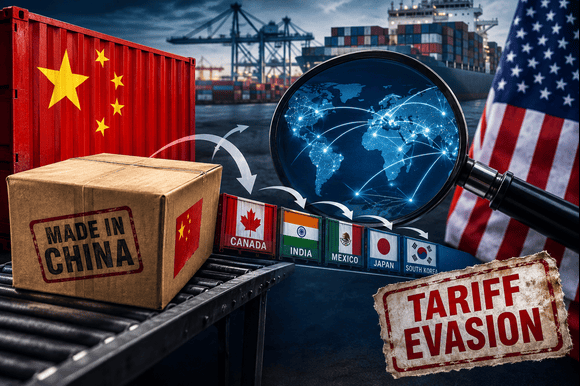
The White House has accused more than 40 countries of helping China circumvent US tariffs by routing Chinese exports through countries that face lower American import duties.
In a report released on Thursday, the White House alleged that nations including Canada, India, Mexico, Japan and South Korea had been used as transit points for Chinese goods, allowing China to avoid tens of billions of dollars in tariffs imposed on companies importing products into the United States.
US trade adviser Peter Navarro said the practice had harmed American businesses and workers while depriving the US government of significant tariff revenue.
“It has cost American jobs and billions in revenue,” Navarro said.
The allegations come at a particularly sensitive moment in relations between Washington and Beijing, with tensions over trade and economic policy continuing despite periods of negotiations and temporary tariff pauses.
China has rejected the accusations and criticised Washington’s broader tariff strategy.
A spokesperson for the Chinese embassy in Washington said that “trade wars have no winners” and reiterated Beijing’s opposition to US tariff measures and what it described as the use of state power to target Chinese companies.
The spokesperson also warned that any action involving goods being transferred through third countries should not harm countries that are not directly involved in the US-China trade dispute.
“Any unilateral actions or agreements concerning transshipped goods must not target or harm the interests of third parties,” the spokesperson said.
The BBC has contacted the US embassies of Canada, India, Mexico, Japan, South Korea and other countries named in the White House report for their responses to the allegations.
Billions of dollars in goods allegedly rerouted
The White House report focuses on a practice known as transshipping, in which goods are transported through an intermediate country before reaching their final destination.
According to government and private-sector estimates cited in the report, between $30bn (£22bn) and approximately $300bn worth of goods may have been moved through countries with lower US tariff rates rather than being shipped directly from countries facing higher duties.
Washington claims China has increasingly exploited this system to reduce the tariffs paid on Chinese products entering the US market.
The White House alleged that Chinese companies have used third countries as stopover points and, in some cases, repackaged or relabelled products in an effort to conceal their true country of origin.
The administration described the alleged activity as “fraud cloaked in paperwork”, arguing that the practice allows Chinese exporters to obtain tariff advantages they would not otherwise qualify for.
The report used particularly strong language to describe the alleged network, saying the scale and sophistication of what it called the “Great Transshipment Scam” had increased significantly.
“What has changed in today’s Great Transshipment Scam is not merely the speed and scale of this modern form of smuggling, but the breadth, depth, and sophistication of the global Shadow Transshipment Network through which China’s tariff evasion now moves,” the White House said.
The administration also said the United States had begun deploying artificial intelligence tools to identify and investigate suspected transshipment operations.
The use of AI, according to the report, is intended to help US authorities analyse trade flows and identify unusual patterns that could indicate that products are being routed through third countries to avoid tariffs.
Countries caught between US and China
The allegations place countries that maintain significant trading relationships with both the United States and China in a difficult position.
Canada, India, Mexico, Japan and South Korea are all major economies with extensive commercial links to China and the US. Their manufacturers and exporters are deeply integrated into international supply chains, meaning that products may legitimately pass through multiple countries before reaching consumers.
The White House report therefore raises questions about how Washington will distinguish between legitimate changes in global production and supply-chain arrangements and deliberate attempts to evade tariffs.
Chang Pao Li, an associate professor of economics at Singapore Management University, said the report could provide the Trump administration with additional leverage as Washington prepares for negotiations with Beijing.
She told the BBC that the findings could be used to strengthen the US bargaining position by arguing that Chinese products were continuing to gain indirect access to the American market even when direct Chinese exports were subject to higher tariffs.
“Washington can argue that China has preserved access to the US market indirectly and that any broader trade settlement must therefore address not only direct Chinese exports but also third-country routing,” she said.
However, Chang also cautioned that not every change in trade routes should automatically be interpreted as tariff evasion.
She said some shifts in trade flows could reflect legitimate decisions by companies to relocate production, diversify manufacturing bases or reorganise supply chains in response to changing economic conditions.
At the same time, she warned that economies with close links to Chinese manufacturing could face new financial and regulatory pressures as Washington increases its scrutiny of international trade routes.
“Economies with deeper integration with Chinese supply chains may now face additional risk and costs,” she said.
Trade tensions continue despite tariff pause
The report comes as the US and China continue to navigate a fragile trade relationship.
Washington and Beijing agreed to pause most of their tariffs following negotiations in May 2025, easing some of the immediate pressure between the world’s two largest economies.
However, the broader dispute has not disappeared.
Both countries have continued to introduce sanctions and restrictions targeting strategic industries and sensitive technologies.
Among the areas affected have been restrictions involving humanoid robots shipped to the United States and tighter Chinese controls on exports of drones.
The continuing measures indicate that the US-China trade conflict extends beyond traditional tariffs and now encompasses technology, manufacturing, supply chains and national security concerns.
The White House report is likely to become another important issue in discussions between US President Donald Trump and Chinese President Xi Jinping, who are expected to meet in Washington in September.
The meeting could provide an opportunity for the two governments to discuss tariffs and trade barriers, but the issue of goods entering the US through third countries could make negotiations more complicated.
Washington is expected to argue that any future agreement must account for indirect trade routes and ensure that tariff reductions or exemptions cannot simply be bypassed by sending Chinese goods through other economies.
Trump continues tariff strategy
Trump’s administration has repeatedly promoted tariffs as a central part of its economic strategy, arguing that higher duties on imports can encourage companies to manufacture more goods in the United States, protect American industries and create domestic jobs.
In April 2025, Trump announced sweeping tariffs affecting dozens of US trading partners.
The administration argued that the measures were necessary to address trade imbalances and protect American economic interests.
However, the tariffs faced significant legal challenges.
The US Supreme Court later struck down the tariffs in question, but Trump has continued to pursue his tariff agenda by relying on alternative legal authorities to impose new duties.
The administration’s latest focus on transshipment suggests that the White House is seeking to close what it views as another route through which foreign companies can avoid US trade restrictions.
For China, the allegations represent another potential obstacle ahead of the Trump-Xi meeting.
Beijing has consistently opposed unilateral US tariffs, arguing that trade disputes should be resolved through dialogue rather than economic pressure.
Chinese officials have also warned that restrictions imposed by Washington can disrupt global supply chains and negatively affect businesses and consumers in countries that are not directly involved in the dispute.
The latest White House report, however, indicates that Washington is increasingly looking beyond direct Chinese exports and examining the wider international networks through which Chinese products reach American consumers.
If the US expands its crackdown on alleged transshipment, companies across Asia and North America could face greater scrutiny over the origin of their products and the routes used to transport them.
That could add another layer of uncertainty to already complicated global supply chains and potentially make the upcoming Trump-Xi talks even more significant for international trade.
With billions of dollars in goods potentially affected, the dispute over transshipment is likely to remain a major point of contention between Washington and Beijing as both sides attempt to negotiate the future of their increasingly strained economic relationship.