

At least 38 people have been killed after a powerful 7.7-magnitude earthquake struck Indonesia’s Flores island early on Saturday, according to the country’s disaster mitigation agency, as emergency teams began search and rescue operations across badly affected areas.
The official death toll continued to rise as authorities assessed the destruction caused by the main earthquake and a series of strong aftershocks. Indonesia’s disaster mitigation agency, known as BNPB, said several people had also suffered injuries of varying severity.
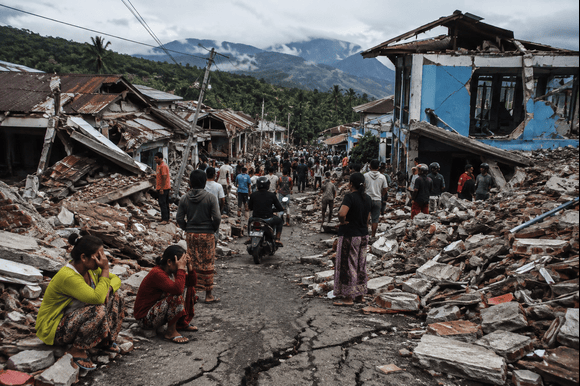
The earthquake caused extensive damage to buildings across parts of the region, while dozens of aftershocks further unsettled residents and complicated rescue efforts.
The powerful tremor struck Flores shortly before 05:00 local time on Saturday, corresponding to 22:00 GMT on Friday. Indonesia’s meteorology and geophysics agency said the earthquake occurred at a depth of about 15km.
Earthquakes that occur relatively close to the Earth’s surface can cause greater destruction because their energy reaches buildings and communities with less distance to travel. Authorities warned that the continuing aftershocks could cause additional damage to already weakened structures.
Several strong aftershocks were recorded following the main earthquake, including one measuring 6.1 in magnitude, increasing fears among residents and emergency workers.
Dramatic video footage from the port in Maumere showed sections of concrete breaking away from a terminal building and falling onto passengers who had been waiting to board an inter-island ferry.
Some passengers were reportedly thrown into the sea after a gangway leading to one of the ships collapsed during the earthquake.
Emanuel Melkiades Laka Lena, governor of East Nusa Tenggara province, said during a news conference that some victims had been killed while sleeping when buildings and rubble collapsed around them.
The governor said authorities were continuing to assess the scale of the disaster as rescue teams were deployed to communities affected by the earthquake.
Residents described moments of panic as the ground began shaking violently before dawn.
Arnold Welianto, who lives in Talibura, a coastal village in Sikka, East Nusa Tenggara, said he was suddenly awakened by what he described as “very strong shaking”.
Speaking to the BBC, Welianto said his immediate concern was the safety of his child.
“I was startled awake and immediately went to my child’s room,” he said.
He said many residents had already begun fleeing towards higher ground and the surrounding hills after the earthquake.
“Some other residents were standing along the roadside because the sea had also receded,” Welianto explained.
He said the water level remained unusually low for a considerable period, causing widespread fear among residents who worried that a tsunami could follow the earthquake.
“The water remained low for quite some time, so everyone panicked and ran,” he said, adding that he went towards a community health centre where people had already been evacuated.
Authorities issued a tsunami warning shortly after the earthquake, prompting residents in coastal communities to move inland and seek higher ground.
A large number of people could be seen travelling away from coastal areas on motorbikes after the warning was announced. BNPB said around 2,000 people had evacuated or relocated themselves as a precaution.
The tsunami warning was lifted approximately three hours after the initial earthquake after monitoring systems detected no significant rise in sea levels.
Despite the lifting of the warning, residents remained cautious because of the continuing aftershocks and the possibility of further structural collapses.
BNPB said fatalities had been reported across several provinces. Three deaths were recorded in Sikka province, six in Manggarai province and five in East Manggarai province, while authorities continued to gather information from remote communities.
The disaster agency also reported that at least two people had suffered serious injuries and another 11 had sustained minor injuries in the initial assessment.
Welianto said many residents in Talibura were refusing to return to their houses because they remained frightened by the continuing tremors.
Some people chose to spend the night outside rather than risk being trapped inside buildings that could potentially collapse during another strong aftershock.
Yulian Juita Ekalia, a university lecturer from Ruteng, a city located west of the earthquake’s epicentre, described the experience as one of the strongest earthquakes she had ever felt.
She told AFP that she had even moved her stove outside and was preparing food outdoors because she feared another major tremor could strike.
“I have never felt an earthquake this big,” she said. “It felt like we were on a trampoline – it was really scary.”
Emergency authorities warned that it could take considerable time to determine the full extent of the destruction because some of the affected communities are located in remote and mountainous parts of the region.
Initial assessments indicated that at least 54 houses had suffered severe damage. Five healthcare facilities were also damaged, along with three places of worship, six government buildings, one educational institution and a warehouse.
BNPB identified Manggarai province as one of the areas most severely affected by the earthquake.
Rescue and emergency teams were working to reach affected communities, assess damaged infrastructure and provide assistance to people who had been forced to leave their homes.
Authorities urged residents to remain calm and follow official instructions while emergency assessments continued.
People living near the coast were advised to remain cautious and stay away from coastal areas unless authorities confirmed it was safe to return. Residents were also warned not to enter buildings that had suffered visible structural damage because further aftershocks could trigger collapses.
The earthquake struck a region already accustomed to seismic activity. Indonesia is one of the world’s most earthquake-prone countries and also experiences frequent volcanic eruptions because it sits along the meeting point of three major tectonic plates.
The country forms part of the Pacific “Ring of Fire”, a region characterised by intense tectonic activity, frequent earthquakes and numerous active volcanoes.
The latest disaster has once again highlighted the risks faced by communities across Indonesia, particularly those living in remote coastal and mountainous areas where reaching affected populations can be difficult after a major earthquake.
As search and rescue operations continue, authorities are expected to provide further updates on casualties, injuries and damage as emergency teams gain access to more affected areas.