


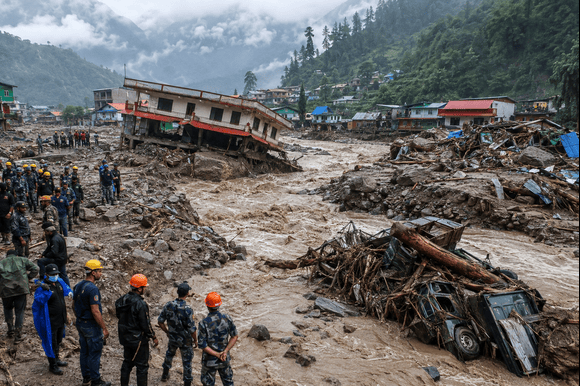
KATHMANDU — Nepal is facing one of its most devastating flood disasters in years after a massive flash flood swept through Himalayan communities near the Nepal-China border, killing hundreds of people and leaving more than 1,400 others missing.
The disaster began on Wednesday, August 26, after a huge collapse of ice, rock and debris in the Himalayan mountains triggered a sudden surge of water through river valleys. The resulting flood devastated communities in northern Nepal and also affected areas across the border in China’s Tibet region.
Nepali authorities reported that at least 359 people had been killed in Nepal, while China confirmed three deaths in Tibet. More than 1,400 people are believed to be missing across the two regions, although casualty figures remain fluid as rescue teams continue searching through destroyed villages and infrastructure.
Massive Flash Flood Sweeps Through Himalayan Valleys
The flooding struck particularly hard in Nepal’s Rasuwa district and surrounding areas, where the Bhotekoshi River and other waterways rose rapidly.
The sudden torrent carried enormous quantities of mud, rocks, trees and debris through valleys, destroying homes, bridges, roads and other infrastructure. Communities located close to rivers had little time to respond as the water surged downstream.
Residents described scenes of extraordinary destruction, with vehicles, houses and other structures swept away by the force of the water.
The disaster also affected major routes connecting Nepal with Tibet. Roads that serve local communities, tourists, traders and pilgrims were damaged or completely destroyed, making access to affected areas extremely difficult.
Glacial Collapse Believed to Have Triggered Disaster
Scientists and disaster experts believe the flooding was not simply the result of heavy monsoon rainfall.
Preliminary assessments indicate that a massive ice-and-rock avalanche or glacial collapse occurred in the upper Himalayan region. The debris may have temporarily blocked a river before the accumulated water suddenly broke through, producing a powerful downstream flood.
Reuters reported that experts believe an ice-rock avalanche on the Lhende Khola river triggered the devastating event. Scientists have also linked the growing instability of Himalayan glaciers and mountain slopes to rising temperatures and climate change.
The Hindu Kush Himalaya region is particularly vulnerable to the effects of a warming climate. Rising temperatures are accelerating glacier melt and can destabilise frozen mountain terrain, increasing the possibility of cascading disasters involving avalanches, landslides and sudden floods.
Villages and Infrastructure Destroyed
The flood caused extensive damage across northern Nepal.
Authorities said at least 19 motorable bridges and around 40 kilometres of roads were damaged or swept away. Several hydropower facilities were also affected, disrupting electricity production and transmission.
The Nepal Electricity Authority reported damage to approximately 430 megawatts of electricity-generating capacity, including hydropower and solar facilities.
The destruction of roads and bridges has complicated the relief effort, leaving some communities isolated and making it difficult for rescue workers to reach people trapped in remote mountain areas.
Hundreds of Foreign Nationals Missing
The disaster has also created an international emergency because the affected region is popular with tourists, trekkers and religious pilgrims.
Hundreds of foreign nationals are among those reported missing. Many people were travelling toward Mount Kailash in Tibet, one of the most important pilgrimage destinations in the Himalayan region.
Missing people reportedly include citizens from India, the United States, the United Kingdom, Australia, Canada and several other countries.
Indian nationals make up a significant proportion of the foreign people reported missing, with many believed to have been travelling on pilgrimage routes.
Families in several countries are anxiously waiting for information about relatives who were in the region when the flood struck.
Rescue Operations Underway
Nepal has launched a major search-and-rescue operation involving the army, police and other emergency agencies.
Military helicopters have been deployed to reach areas cut off by damaged roads and bridges. Rescue personnel are searching through mud and debris for survivors and missing people.
The difficult Himalayan terrain, continuing bad weather and damaged communication networks are making the operation extremely challenging.
Authorities have also warned residents to stay away from major rivers, including the Bhotekoshi, Trishuli and Narayani, because of continuing flood risks.
Emergency teams are facing the additional challenge of transporting injured people and recovered bodies from isolated areas to hospitals and safer locations.
Concerns Over Another Flood Threat
Officials and scientists are also monitoring the possibility of further flooding.
The disaster reportedly created a large accumulation of water behind debris and blocked river channels. Authorities fear that if such a temporary natural dam collapses, another sudden surge could hit communities downstream.
The possibility of additional landslides and mudslides remains high because of unstable mountain slopes and continuing rainfall.
Residents in vulnerable riverbank areas have therefore been urged to move to safer locations.
Nepal Faces Wider Monsoon Disaster Risk
The catastrophe comes during Nepal’s annual monsoon season, when heavy rainfall frequently causes floods, landslides and other disasters.
Before the latest catastrophe, Nepal Police had already reported 85 deaths from monsoon-related disasters between April 14 and August 14, 2026. The deaths included victims of floods, landslides, lightning strikes, heavy rain and an avalanche. The latest flash flood has dramatically increased the scale of the disaster and highlighted the country’s vulnerability to extreme weather and mountain hazards.
China Also Launches Emergency Response
The disaster crossed the Nepal-China border, with severe damage reported in Tibet’s Gyirong County.
Chinese authorities confirmed deaths and hundreds of people missing after a landslide and flood struck the area around Gyirong Port, an important crossing between Nepal and Tibet.
China has deployed emergency teams and called for an intensive search-and-rescue operation. Officials have also warned of continuing mudslide risks in the region.
The two countries are therefore dealing with a shared humanitarian emergency in one of the world’s most difficult geographical environments.
Humanitarian Crisis Deepens
Beyond the immediate death toll, the disaster has created major humanitarian challenges.
Thousands of people in affected communities face uncertainty over shelter, food, drinking water, electricity and access to healthcare. Destroyed roads and bridges are making it difficult to deliver essential supplies.
Hospitals and emergency services are also dealing with casualties while authorities work to identify recovered bodies and reunite survivors with their families.
For families of missing people, the rescue operation has become a desperate race against time.
Climate Change Raises Long-Term Concerns
The disaster has renewed concerns about the growing risks posed by climate change in the Himalayas.
Experts have warned that warmer temperatures are contributing to glacier loss and increasing instability in mountain environments. Nepal has lost a substantial portion of its glacier ice over recent decades, while thawing ice and unstable slopes can create dangerous conditions for downstream communities.
The latest catastrophe demonstrates how a single mountain event can trigger a chain reaction involving glacier collapse, landslides, river blockage and catastrophic flooding.
Scientists say improved monitoring systems, early-warning technology, stronger infrastructure and better emergency planning will be essential to protect communities living in vulnerable Himalayan valleys.
Search for Survivors Continues
As rescue teams continue their operations, the full scale of the destruction is still emerging.
Authorities expect casualty and missing-person figures to change as rescuers reach isolated areas and communications are restored.
For Nepal, the disaster represents a major national emergency, while the large number of missing foreign nationals has given the catastrophe an international dimension.
With hundreds of lives lost and more than 1,400 people still unaccounted for across Nepal and Tibet, the priority remains finding survivors, providing emergency assistance and preventing further loss of life.
The devastating floods have also delivered a stark warning about the increasing dangers facing communities in the Himalayan region, where extreme weather, unstable glaciers and vulnerable infrastructure are combining to create increasingly serious disaster risks.