


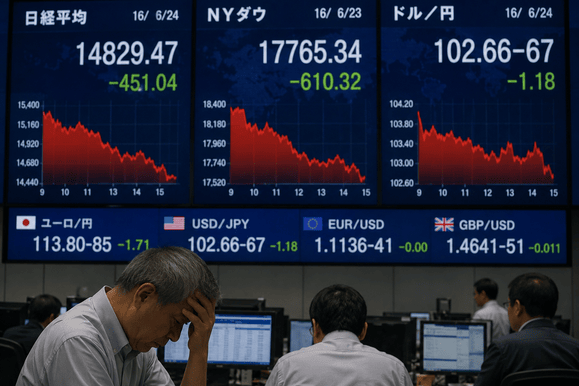
Tokyo, June 26, 2026 — Stock markets across Asia posted sharp losses on Friday as a widespread sell-off in technology shares rattled investor confidence, with concerns mounting that soaring valuations in the sector have outpaced underlying business fundamentals following months of strong gains.
The regional decline was led by heavy selling in major technology companies as investors reassessed the outlook for artificial intelligence-related investments, rising production costs and premium share prices that many analysts believe have become increasingly difficult to justify.
South Korea experienced the most dramatic market turbulence, where trading on the benchmark Kospi Index was temporarily suspended after the market plunged by 8%, triggering the country’s automatic circuit breaker system designed to prevent panic-driven selling.
The emergency trading halt lasted approximately 20 minutes before market activity resumed. Although the index recovered some of its losses after trading restarted, it still ended the session down 5.8%, marking one of its steepest single-day declines this year.
Financial analysts said investor sentiment deteriorated rapidly as technology shares came under intense pressure, prompting broad selling across multiple sectors and increasing market volatility.
The downturn followed a difficult session on Wall Street, where Apple shares suffered a sharp decline after the company announced price increases for several of its flagship consumer products, including iPads and MacBooks.
Apple attributed the higher retail prices to the rising cost of semiconductor components and other manufacturing expenses, signalling that increasing production costs are beginning to affect consumer electronics more directly.
The announcement fuelled concerns that higher prices could weaken consumer demand for electronic devices, ultimately affecting sales across the broader technology supply chain, including semiconductor manufacturers and hardware producers.
Investors are also becoming increasingly cautious about the enormous sums being invested in artificial intelligence infrastructure by the world’s largest technology companies.
Over the past year, major firms have committed hundreds of billions of dollars toward expanding data centres, purchasing advanced semiconductor equipment and developing next-generation AI systems in anticipation of continued growth in demand for artificial intelligence services.
While many investors continue to believe that AI will transform numerous industries over the long term, questions are emerging over whether current spending levels and market valuations accurately reflect future earnings potential.
David Makaryan, Senior Partner at investment firm Alpha Pacific Group, said investors are becoming more selective after months of strong market gains driven largely by enthusiasm surrounding artificial intelligence.
According to Makaryan, the long-term investment case for AI remains attractive, but market participants are increasingly distinguishing between companies with sustainable growth prospects and those whose valuations have been driven primarily by investor optimism.
He noted that after an extended rally, many traders are choosing to lock in profits while reassessing whether share prices still reflect realistic expectations for future business performance.
Japan’s stock market also experienced significant losses during Friday’s trading session.
The Nikkei 225 Index closed more than 4% lower, weighed down by sharp declines among technology and semiconductor-related companies.
Among the biggest losers was technology investment conglomerate SoftBank Group, whose shares tumbled 12.5% as investors reduced exposure to high-growth technology businesses amid the broader market correction.
Elsewhere in the region, major equity markets in Taiwan and mainland China also recorded notable declines as weakness spread throughout Asia’s technology sector.
Market strategists said the sell-off reflected a regional reassessment of technology stocks rather than company-specific developments, with investors broadly reducing risk exposure following recent gains.
South Korea has experienced particularly volatile trading conditions in recent months, with rapid swings in investor sentiment producing frequent periods of sharp market movement.
Friday’s temporary suspension of trading marked the third activation of the Kospi’s circuit breaker mechanism within the same week and the fifth such occurrence since the beginning of the year, highlighting the heightened uncertainty currently affecting financial markets.
The weakness in Asia followed heavy selling in US technology shares during Thursday’s trading session.
Apple stock fell 6%, representing the company’s largest single-day decline in more than twelve months after the announcement regarding higher product prices.
Microsoft also came under pressure after revealing that prices for several Xbox gaming consoles would increase because of rising component and manufacturing costs.
The announcements from two of the world’s largest technology companies reinforced investor concerns that higher production expenses are beginning to affect consumer demand and corporate profitability across the electronics industry.
Analysts warn that if device manufacturers continue raising prices, consumers may delay purchasing new products, reducing demand for semiconductors and slowing growth across the wider technology ecosystem.
Another major concern for investors is the enormous financial commitment required to commercialise artificial intelligence technologies.
Technology companies continue investing heavily in advanced computing infrastructure, cloud facilities and specialised AI chips, but many analysts caution that generating returns on those investments could take considerably longer than markets currently anticipate.
Raymond Woo, an analyst at Kyoto University Innovation Capital, said companies are increasingly passing the costs associated with developing artificial intelligence platforms on to consumers through higher prices for products and digital services.
According to Woo, the trend naturally raises questions about how quickly consumer demand for AI-powered products and services will expand relative to the unprecedented levels of corporate investment now flowing into the sector.
He added that investors are beginning to ask whether current technology valuations accurately reflect future earnings potential or whether expectations surrounding artificial intelligence have become overly optimistic.
Despite Friday’s sharp market decline, many investment professionals continue to view artificial intelligence as one of the most important long-term growth themes for the global economy.
However, analysts caution that as enthusiasm surrounding AI matures, financial markets are likely to place greater emphasis on profitability, sustainable revenue growth and execution rather than ambitious projections alone.
For now, investors appear increasingly willing to scrutinise company valuations more carefully, suggesting that technology stocks could experience continued volatility as markets balance optimism over AI’s future against concerns over rising costs, slowing demand and increasingly demanding investor expectations.