

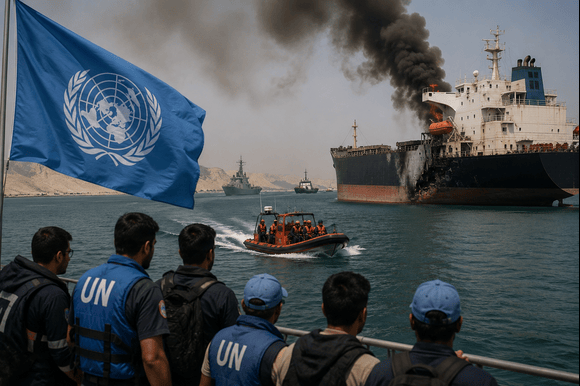
Geneva, June 26, 2026 — The United Nations’ International Maritime Organization (IMO) has temporarily halted its large-scale evacuation operation for thousands of sailors stranded in the Strait of Hormuz after a commercial cargo vessel was attacked while transiting the strategic waterway, raising fresh concerns over maritime security despite ongoing diplomatic efforts to stabilize the region.
IMO Secretary-General Arsenio Dominguez announced that the evacuation program, which was intended to assist more than 11,000 seafarers trapped in the Gulf since the outbreak of the Iran conflict, would be suspended until authorities receive stronger assurances that navigation through the strait can be conducted safely.
Dominguez said that while several evacuation missions had already been completed successfully, the organization could not continue the operation without guarantees that ships participating in the humanitarian effort would remain protected from potential attacks.
The decision followed an incident reported on Thursday in which a commercial vessel sailing near the Strait of Hormuz was struck by what British maritime authorities described as an unidentified projectile.
According to the United Kingdom Maritime Trade Operations (UKMTO), the incident occurred approximately 7.5 nautical miles southeast of the Omani port of Dahit. Although the vessel sustained damage, no injuries or fatalities among the crew were reported.
The attack has significantly heightened tensions in one of the world’s busiest shipping corridors and has cast uncertainty over international efforts to restore confidence among commercial shipping companies operating in the Gulf.
The latest incident occurred only days after Iran’s Islamic Revolutionary Guard Corps (IRGC) warned that ships travelling through the Strait of Hormuz outside routes approved by Tehran would be considered to be operating under unsafe conditions. Iranian authorities urged vessel operators to coordinate directly with Iranian naval officials before attempting to transit the strategic passage.
American officials, speaking to several US media outlets, alleged that Iranian forces were responsible for firing on the cargo vessel. Tehran has not publicly accepted responsibility for the incident, and Iranian authorities have yet to issue an official response to the allegations.
Maritime security company Vanguard identified the targeted vessel as the Ever Lovely, a Singapore-flagged cargo ship that continued its voyage despite being struck.
Tracking information from the maritime monitoring platform MarineTraffic indicated that the Ever Lovely had been travelling through a southern navigation corridor identified by the IMO earlier on Thursday. The route had been promoted as part of international efforts to facilitate safer movement through the Gulf following months of conflict.
According to reports, the Ever Lovely was leading a convoy of five commercial vessels travelling together through the strait. Crew members aboard other ships in the flotilla reportedly told media outlets that they received no radio warnings or instructions from Iranian naval forces before the attack occurred.
Responding to the incident, Dominguez emphasized that the targeted vessel had not been operating as part of the IMO’s organized evacuation framework.
He said the organization’s highest priority remains the protection of seafarers and stressed that evacuation operations would remain suspended until greater clarity is obtained regarding the security environment and safe navigation procedures within the Strait of Hormuz.
The humanitarian operation was launched earlier this week after international negotiations helped reopen the waterway following months of closure caused by the conflict between Iran, the United States and Israel.
The evacuation programme was designed to assist thousands of sailors who had remained stranded aboard merchant vessels after shipping activity across the Gulf was severely disrupted by military operations and security concerns.
When announcing the initiative, the IMO said the operation had been coordinated with Iran, Oman, the United States, other coastal nations bordering the Gulf and representatives of the global maritime industry.
However, the latest attack has raised new questions about whether those security arrangements remain sufficient to guarantee the safe passage of commercial and humanitarian shipping.
Iranian authorities have continued to insist that vessels must use navigation routes designated by Tehran if they wish to receive security guarantees while passing through the Strait of Hormuz.
Earlier this week, the Persian Gulf Strait Authority (PGSA), the body established by Iran to oversee traffic through the waterway, warned that ships choosing unauthorized routes would do so entirely at their own risk.
The authority stated that any consequences resulting from navigation outside officially approved corridors would be the responsibility of vessel owners, operators and ship captains.
Despite those warnings, many international shipping companies have continued using an alternative southern route that closely follows Oman’s coastline. Maritime operators have argued that the corridor offers greater safety and has received support from international navigation authorities.
The disagreement reflects wider tensions over who should oversee maritime traffic in one of the world’s most strategically important waterways.
The latest developments come despite the ceasefire agreement reached last week between Washington and Tehran under a comprehensive 14-point framework designed to end months of fighting.
As part of that agreement, Iran committed to making its best efforts to facilitate the safe movement of commercial shipping through the Strait of Hormuz for a period of 60 days while broader negotiations continue over Tehran’s nuclear programme and regional security issues.
Nevertheless, Iranian officials have repeatedly maintained that commercial vessels using the waterway will eventually be required to pay what Tehran describes as maritime service charges rather than traditional transit tolls.
The proposal has generated strong opposition from the United States and several of its allies.
US Secretary of State Marco Rubio warned earlier this week that no country has the legal authority to impose mandatory fees on vessels transiting the Strait of Hormuz, describing the passage as an international waterway protected under international maritime law.
Rubio is currently visiting Bahrain as part of a regional diplomatic tour focused on discussions with Gulf allies regarding implementation of the recent agreement with Iran and broader efforts to maintain stability across the region.
The Strait of Hormuz has remained at the centre of international attention since hostilities erupted earlier this year following military strikes against Iran by the United States and Israel.
During the conflict, Tehran effectively closed the narrow passage by restricting commercial navigation, triggering immediate concerns over global energy supplies and causing oil prices to surge.
The disruption also affected shipments of liquefied natural gas, fertilizers and numerous other commodities that rely on uninterrupted access through the Gulf.
Since the signing of a Memorandum of Understanding between Washington and Tehran on June 17, however, conditions have gradually improved.
The agreement established a 60-day negotiating period covering Iran’s nuclear programme and other measures intended to prevent a return to armed conflict.
Improving security conditions have encouraged more commercial vessels to resume operations, helping ease fears of prolonged supply disruptions.
Reflecting renewed market confidence, international oil prices have continued to decline from the highs recorded during the conflict. On Thursday, Brent crude briefly traded below $72.50 per barrel, returning to levels last seen before military operations began earlier this year, before recovering modestly to around $73.23.
Despite the recent improvement in energy markets, Thursday’s attack demonstrates that the security situation in the Strait of Hormuz remains fragile. Shipping companies, governments and international organizations continue to monitor developments closely as diplomatic negotiations proceed, aware that any renewed escalation could once again disrupt one of the world’s most vital maritime trade routes and send shockwaves through global energy markets.