


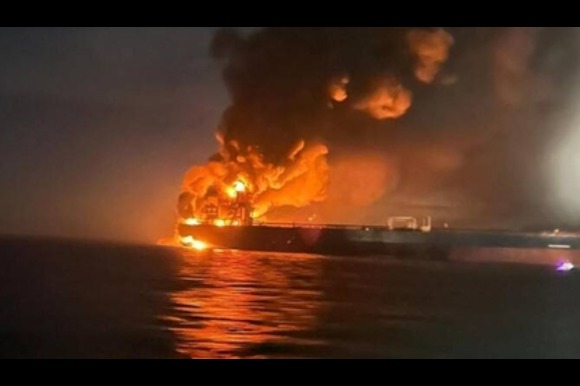
The death toll from a Russian missile strike on a cargo ship off the coast of Ukraine’s Black Sea port city of Odesa has increased to 10, Ukrainian officials have confirmed.
The Guinea-Bissau-flagged vessel, identified as the Golden Leo, was hit by Russian cruise missiles on Sunday, according to the Ukrainian Air Force. The attack sparked a major fire onboard the ship, prompting an immediate search and rescue operation that continued throughout the night.
By Monday morning, Ukraine’s seaports authority reported that nine crew members had been killed in the strike, along with one Ukrainian pilot who was assisting the vessel. The incident has become the deadliest known Russian attack on a civilian cargo ship operating in the Black Sea since the beginning of the full-scale war.
The Odesa region has faced a growing wave of Russian attacks in recent weeks. Regional governor Oleh Kiper told Ukrainian television on Monday that 28 people had been killed in Russian strikes across the region during July alone, highlighting the increasing intensity of attacks targeting the area.
At the same time, Russian strikes against commercial vessels in the Black Sea have become more frequent, raising concerns among shipping companies and international traders over the safety of Ukraine’s remaining maritime export routes.
The Golden Leo attack marks a significant escalation because foreign-flagged cargo ships with international crews play a crucial role in maintaining Ukraine’s last operational maritime export corridor. The route allows Ukrainian goods to travel along the Romanian and Bulgarian coastlines before reaching Turkey and global markets.
Ukraine relies heavily on these maritime exports, particularly for its agricultural sector. More than two-thirds of Ukraine’s agricultural exports are transported through sea routes, generating around $9 billion (£6.7 billion) in revenue. These exports remain a vital economic lifeline for Kyiv as the country continues to deal with the financial pressures caused by the ongoing war.
The Black Sea conflict had largely remained at a stalemate for much of the four-and-a-half years since Russia launched its full-scale invasion of Ukraine. Although Russian forces initially controlled large sections of the Ukrainian coastline, limiting Kyiv’s naval operations, Ukrainian drone attacks forced Moscow to move many of its naval assets into protected bases in the eastern Black Sea.
However, Russia’s increasing attacks on commercial cargo ships are believed to be part of an effort to discourage international companies from purchasing Ukrainian goods and using the country’s maritime corridor.
Ukraine’s Prime Minister Serhiy Koretskyi said on Sunday that the government and military leadership were preparing new measures aimed at improving navigation safety and protecting civilian vessels and seafarers from further Russian attacks.
Despite continued missile and drone strikes, Odesa remains one of Ukraine’s most popular coastal destinations, attracting visitors during the summer season.
Earlier this month, Governor Oleh Kiper announced that air raid shelters had been established at 40 beaches across the region, allowing them to remain open to the public. However, he warned that coastal areas could be especially dangerous because Russian drones and missiles are frequently launched from the sea.
Ukraine has also increased its own attacks against Russian military and logistical assets in the Black Sea and the Sea of Azov.
On Monday, Ukraine’s drone forces commander Robert Brovdi claimed that 183 vessels had been targeted during July. Although the figure has not been independently verified, satellite imagery reviewed by international observers has shown evidence of damage to multiple vessels in both the Black Sea and the Sea of Azov.
Beyond the maritime conflict, Russian strikes continued across other parts of Ukraine. Five people were killed in separate Russian attacks targeting cities in eastern and southern Ukraine, according to Ukrainian officials.
The United Nations reported that June recorded the highest number of Ukrainian civilian casualties since April 2022. At least 293 civilians were killed and another 1,990 injured during the month, reflecting the growing impact of intensified attacks on populated areas.
Meanwhile, Ukraine continued operations against targets inside Russia, striking logistics facilities and an oil depot in the Moscow region.
Moscow Mayor Sergei Sobyanin said Kyiv launched around 400 drones toward the Russian capital overnight on Monday, though he claimed most of the drones were intercepted by Russian air defences. Local authorities later reported that 10 people had been injured in the attacks.
In Russia’s Belgorod border region, local officials said a Ukrainian drone strike hit a bus on Monday, killing five people, including a child. Ukraine has not yet issued a statement regarding the incident.
The latest developments underline the continued escalation of attacks on both sides, with civilian infrastructure, commercial shipping routes, and logistical networks increasingly becoming targets in the ongoing Russia-Ukraine conflict.