

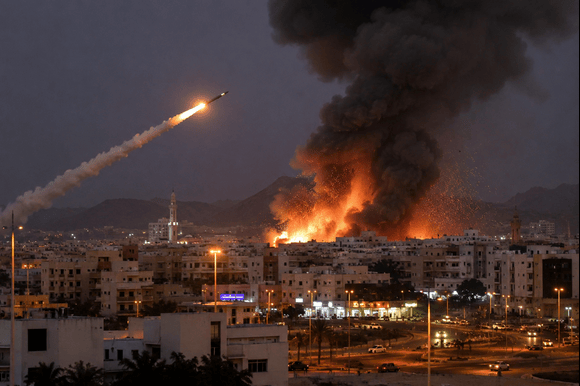
Iran-backed Houthi forces have claimed responsibility for launching a missile attack on Saudi Arabia after Riyadh carried out air strikes targeting Houthi positions in Yemen, marking another escalation in the widening regional conflict.
According to the Houthis’ Ansarollah media outlet, a missile launched from Yemen struck the Saudi city of Jizan early on Saturday, reportedly igniting fires in parts of the province. The announcement was made through the group’s official Telegram channel, while Saudi authorities issued emergency alerts for residents in the affected area. Riyadh did not immediately confirm the extent of the reported damage or casualties.
The claimed missile strike came just hours after Saudi Arabia launched a series of air raids against Houthi targets in Yemen’s strategic port city of Hodeida and the nearby Kamaran Island on Friday. The Houthis had vowed swift retaliation, accusing Saudi Arabia of targeting civilian infrastructure and escalating the conflict.
In a statement published on Telegram following the exchange of fire, the Houthis condemned the Saudi operation.
“The Saudi enemy’s targeting of civilian facilities in Hodeida and Kamaran Island constitutes a dangerous escalation,” the group declared. “We affirm that these recent crimes will not go unanswered.”
Saudi officials had not released an immediate response to the Houthi statement by Saturday.
The latest exchange of attacks unfolded during an unusual lull in the broader regional conflict, with no overnight reports of fresh air strikes carried out by either the United States or Iran for the first time in two weeks.
The US military did not announce any new operations against Iranian targets on Saturday after conducting 13 consecutive nights of air strikes across Iran. During the same period, Tehran responded by launching drones and missiles at American military installations and bases located throughout the Middle East, significantly increasing regional tensions.
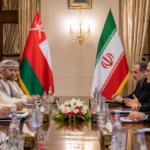
Despite the temporary pause in direct US-Iran strikes, diplomatic activity continued. Earlier on Friday, an Omani delegation arrived in Tehran to discuss the future management of the Strait of Hormuz, according to Iran’s state-run IRNA news agency.
Oman, which controls the southern coastline of the strategically important waterway, has played a long-standing mediating role between Iran and Gulf Arab states. The talks are viewed as part of broader efforts to reduce tensions surrounding one of the world’s most critical maritime trade routes.
Meanwhile, US President Donald Trump signalled that negotiations with Iran remain ongoing while also warning that military action remains an option if diplomacy fails.
Speaking to reporters at the White House on Friday afternoon, Trump said he believed Tehran was engaging more seriously than in previous negotiations.
“We are talking to them. I think they’re being serious. I think they are being by far the most serious that we’ve seen them, but that doesn’t mean we get there,” Trump said.
When asked about his strategy for ending the conflict, the US president outlined two possible paths.
“There’s a military exit where we just keep going just the way we are, and we can even make it a heavier dose, and it’s knocking out everything they have,” he said. “Or there’s a smarter strategy that you make a deal.”
However, Trump also emphasised that the United States remained fully prepared for additional military operations if necessary.
“We’re locked and loaded. We’re ready to go,” he added.
While diplomatic discussions continued, military activity persisted in the Gulf of Oman. On Friday, the US military confirmed that it had intercepted and disabled a commercial tanker attempting to bypass the American naval blockade on Iranian ports.
According to US Central Command, the vessel repeatedly ignored warnings from American naval forces before action was taken.
Navy Captain Tim Hawkins, spokesperson for US Central Command, said the tanker attempted to evade the blockade multiple times.
“We disabled the tanker after the crew attempted to run the blockade at least four times prior,” Hawkins told AFP.
“The crew was repeatedly warned, didn’t comply, and US forces on scene disabled the ship after firing into its engine room,” he said. “The ship is no longer transiting to Iran.”
The vessel became the second commercial ship disabled by US forces since Washington reinstated its maritime blockade against Iran earlier this month, highlighting the increasingly volatile security environment in regional waters.
Growing concerns over threats to international shipping from Yemen’s Houthi movement have also continued to affect global energy markets. Earlier this week, fears of disruptions in the Red Sea and nearby shipping lanes pushed crude oil prices above US$100 (£74.96) per barrel, reaching their highest level since May.
However, oil prices retreated on Friday afternoon after signs that some maritime traffic was continuing despite the security risks. According to Reuters, Brent crude futures fell by more than US$4 (£3.00) to just over US$96 (£72.07) per barrel after two Chinese-chartered supertankers successfully passed through the Bab el-Mandeb Strait without incident.
The latest developments come as international efforts to prevent further escalation continue. The BBC reported that the United States and the United Kingdom are expected to host a high-level conference in London next week focusing on security and freedom of navigation in the Strait of Hormuz.
US Defence Secretary Pete Hegseth and Chairman of the Joint Chiefs of Staff General Dan Caine are expected to participate in the discussions, which were first reported by Axios.
Separately, Israeli Prime Minister Benjamin Netanyahu is scheduled to travel to Washington next week for talks with President Trump at the White House, with regional security expected to dominate the agenda.
The current crisis follows the collapse of a 14-point Memorandum of Understanding signed by the United States and Iran in June. The agreement had aimed to halt military operations, reopen the Strait of Hormuz to commercial shipping and establish a framework for ending the conflict within 60 days.
However, the ceasefire lasted only a few weeks before deteriorating. President Trump later declared the agreement effectively over following renewed Iranian attacks on vessels operating in the Strait of Hormuz and subsequent US military retaliation, setting the stage for the latest cycle of escalating violence across the Middle East.