


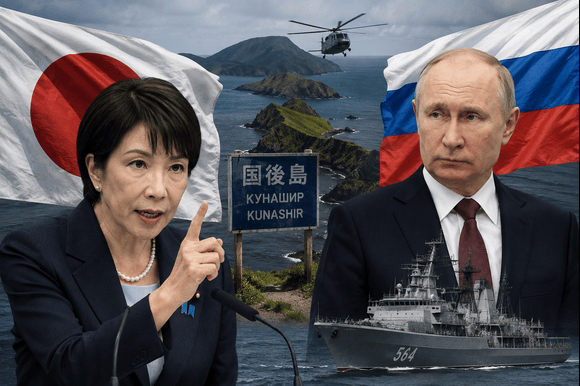
Japan’s Prime Minister Sanae Takaichi has strongly condemned Russian President Vladimir Putin’s first-ever visit to the disputed Kuril Islands, describing the trip as “absolutely unacceptable” and warning that it has further damaged already strained relations between Tokyo and Moscow.
Russian state media reported that Putin travelled to Iturup, known as Etorofu in Japan, on Thursday. The island is one of four southern Kuril Islands claimed by both Russia and Japan and has remained at the centre of a decades-old territorial dispute between the two countries.
The Russian president’s visit has prompted a strong reaction from Tokyo, with Takaichi saying the trip had worsened Japanese public sentiment towards Russia.
“Putin’s visit has worsened Japanese sentiment towards Russia,” Takaichi told reporters.
She reiterated Japan’s long-standing position that the disputed islands constitute a unique part of Japanese territory, both from a historical perspective and under international law.
The prime minister said Putin’s decision to travel to Iturup was deeply offensive to Japan and incompatible with Tokyo’s established position on the territorial dispute.
Japan Calls Putin Visit Unacceptable
Speaking from the prime minister’s office, Takaichi said the Russian leader’s visit had hurt the feelings of the Japanese people.
She described the trip as inconsistent with Japan’s position on what Tokyo calls the Northern Territories, the name Japan uses for the four disputed islands.
Takaichi said she hoped Moscow would recognise the seriousness of the situation and understand the strength of Japan’s objection.
“The trip wounds the feelings of the Japanese people,” she said, adding that the visit was “incompatible with Japan’s consistent position on the Northern Territories”.
Her comments represent another diplomatic protest from Tokyo over Russia’s activities in the disputed territory.
Japan’s Foreign Minister Toshimitsu Motegi also criticised the visit earlier on Thursday.
Motegi said the islands were “inherently Japanese territory both historically and under international law” and confirmed that the Japanese government had strongly protested Putin’s trip.
The coordinated response from Japan’s senior leadership demonstrates the importance Tokyo continues to place on the territorial dispute.
Putin Visits Iturup Island
Putin’s visit to Iturup marks the first time the Russian president has travelled personally to the disputed Kuril Islands.
According to Russian state media, Putin met local residents and sampled fish roe during his visit.
The trip was presented by Russian authorities as part of the president’s engagement with the region and its population.
However, the visit has significant political implications because of the island’s disputed status.
Russia has controlled the Kuril Islands since the final stages of World War Two, while Japan continues to claim the four southernmost islands.
The territorial disagreement has remained unresolved for decades and has prevented the two countries from formally concluding a peace treaty following the Second World War.
Putin’s visit therefore comes against the background of a long-running dispute that has repeatedly complicated efforts to improve bilateral relations.
Decades-Long Territorial Dispute
The Kuril Islands form a chain stretching between Japan’s northern island of Hokkaido and Russia’s Kamchatka Peninsula.
The four southernmost islands — Iturup, Kunashir, Shikotan and the Habomai Islands — are claimed by Japan, which refers to them collectively as the Northern Territories.
Russia administers the islands and considers them part of its sovereign territory.
At the end of World War Two, the Soviet Union took control of the Kuril chain and subsequently deported approximately 17,000 Japanese residents from the islands.
Japan has continued to maintain its territorial claim ever since.
The dispute became one of the main reasons the two countries failed to sign a formal peace treaty after the war.
Although Moscow and Tokyo have held numerous negotiations over the years, efforts to resolve the disagreement have repeatedly stalled.
The territorial issue remains one of the most persistent obstacles to normalising relations between the two countries.
Relations Already Strained by Ukraine War
The latest dispute comes at a time when relations between Japan and Russia are already particularly tense.
Japan joined other Western countries in imposing sanctions on Moscow following Russia’s full-scale invasion of Ukraine in 2022.
Tokyo’s sanctions have contributed to a significant deterioration in bilateral relations.
Russia and Japan have also exchanged diplomatic protests over activities around the disputed islands.
Japanese officials have previously objected to visits by senior Russian officials, including former Russian Prime Minister Dmitry Medvedev and Prime Minister Mikhail Mishustin.
Those visits similarly triggered protests from Tokyo, which maintains that Russian officials’ presence on the islands violates Japan’s territorial claims.
The latest visit by Putin is therefore likely to add another layer of tension to an already difficult relationship.
Russia Strengthens Military Presence
Beyond their symbolic and historical importance, the Kuril Islands have considerable strategic value for Russia.
Moscow has strengthened its military presence across the island chain over the past decade, reinforcing its position in the strategically important region between the Sea of Okhotsk and the northern Pacific.
Iturup is particularly significant because Russia uses the island as a major military air base in the region.
The increased Russian military presence has raised concerns in Japan, particularly as Tokyo has sought to strengthen its own defence capabilities amid growing security challenges in East Asia.
Japanese officials have repeatedly expressed concern about Russian military exercises and deployments around the disputed territories.
Moscow, however, maintains control over the islands and continues to treat the area as an important component of its regional defence strategy.
Russian and Chinese Naval Activity Raises Concerns
The strategic importance of the Kuril Islands has also been highlighted by increased military cooperation between Russia and China.
Last month, Chinese and Russian naval vessels travelled through a strait in the Kuril Islands as part of a joint patrol.
The movement of the two countries’ warships through the strategically important waters attracted attention in Japan and added to concerns about increasing military cooperation between Moscow and Beijing.
Russia also regularly conducts military exercises in and around the Kuril Islands.
Japan has repeatedly protested against such drills, arguing that military activity in the disputed territory is unacceptable.
Moscow has rejected Japanese objections and continued to conduct military activities in the region.
Peace Treaty Remains Elusive
The territorial dispute has prevented Russia and Japan from establishing a comprehensive post-war peace settlement.
Although the two countries have maintained diplomatic relations and engaged in periodic negotiations, the disagreement over the Northern Territories has remained unresolved.
At various points, both governments have explored possible compromises and agreements, but political developments and changing regional security conditions have repeatedly interrupted progress.
The situation became even more complicated following Russia’s invasion of Ukraine and Japan’s decision to impose sanctions against Moscow.
Diplomatic engagement between the two countries has since deteriorated considerably.
The latest dispute over Putin’s visit is therefore unlikely to improve prospects for a breakthrough.
Takaichi Warns of Impact on Japanese Public Opinion
Takaichi’s comments also underline the domestic political importance of the Northern Territories issue in Japan.
The disputed islands remain a sensitive subject for many Japanese people, particularly because of the history of Japanese residents being removed from the territories after World War Two.
Tokyo has consistently argued that the islands are inherently Japanese and has sought their return through diplomatic negotiations.
The prime minister’s decision to publicly describe Putin’s visit as “absolutely unacceptable” reflects the strength of Japan’s position.
Her government is also seeking to make clear that Russia’s actions will not alter Tokyo’s territorial claims.
The Japanese government has called on Moscow to take its objections seriously and avoid actions that could further damage bilateral relations.
A New Source of Tension Between Tokyo and Moscow
Putin’s visit to Iturup is unlikely to resolve the long-standing territorial dispute and could instead further complicate relations between Japan and Russia.
For Moscow, maintaining control over the Kuril Islands has strategic and military significance.
For Tokyo, the four southern islands remain a matter of sovereignty, history and national sentiment.
The disagreement has survived decades of negotiations, political changes and shifting regional security conditions.
The latest visit demonstrates that the dispute remains firmly unresolved.
With Russia strengthening its military presence in the Kurils, conducting regular exercises and increasing cooperation with China, Japan is closely monitoring developments in the region.
Tokyo’s strong reaction also signals that the territorial issue remains a major component of its relationship with Moscow.
As tensions between Russia and Japan continue to deepen over Ukraine, military activity and the disputed islands, prospects for a peace treaty between the two countries remain uncertain.
Putin’s unprecedented visit to Iturup has therefore reopened one of East Asia’s longest-running territorial disputes and delivered another setback to efforts aimed at improving relations between Tokyo and Moscow.