

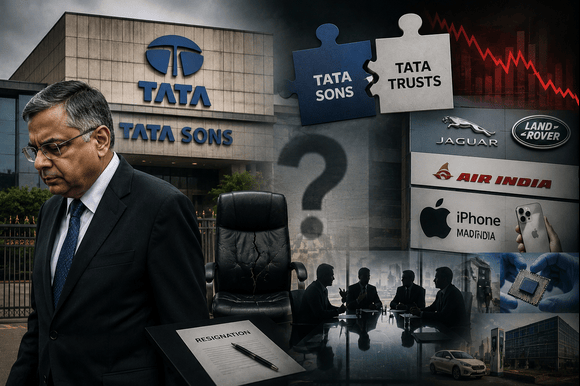
The sudden resignation of Tata Sons chairman N Chandrasekaran has left one of corporate India’s most prestigious leadership positions vacant, creating a major challenge for the Tata Group as it attempts to find a successor capable of steering its sprawling $300bn empire through a period of rapid expansion, rising investment and internal disagreement.
Chandrasekaran stepped down earlier this month following a deadlock over his reappointment and a growing rift with Tata Trusts, the charitable arm that holds controlling shares in Tata Sons, the unlisted commercial holding company at the centre of the Tata conglomerate.
The dispute is understood to have involved disagreements over the possible public listing of Tata Sons and how capital should be allocated among several newer businesses launched or expanded by the group.
Those ventures include semiconductors, e-commerce and aviation, all of which have required significant investment while continuing to generate losses.
The leadership crisis comes at a critical point for the Tata Group, which has embarked on the biggest capital investment programme in its history.
Tens of billions of dollars are being committed to projects ranging from the construction of India’s first semiconductor fabrication plant and electric vehicle battery production to the expansion of its aviation operations.
The group is also attempting to transform Air India after the Tata Group acquired the airline from the Indian government in 2022.
The person who eventually succeeds Chandrasekaran will therefore inherit an organisation undergoing an extraordinary period of expansion, with major opportunities but also significant financial and operational risks.
The new chairman will need to determine whether the group’s aggressive investment strategy remains sustainable and how the risks associated with its newer businesses should be managed.
Hetal Dalal of Institutional Investor Advisory Services, a corporate governance advisory firm, told the BBC that the position would be exceptionally demanding, both for the eventual appointee and for the committee responsible for selecting the new chairman.
The successful candidate will require a broad range of skills and experience, including the ability to manage relationships with Tata Trusts, oversee the Tata Sons board, understand the group’s increasingly diverse businesses and maintain strong relationships with regulators and the Indian government.
“There aren’t many people running such large, diversified conglomerates,” Dalal said, highlighting the difficulty of finding an executive with the necessary experience.
The selection process could also face another challenge: convincing a senior executive currently leading another major organisation to leave their existing position and take responsibility for the Tata Group.
The complexity of the chairman’s role has increased considerably in recent years as the group has expanded into new industries.
Nirmalya Kumar, who previously headed strategy at Tata Sons, said the combined losses of the group’s newer businesses are now greater than the cash flow generated by some of its established companies.
Tata Consultancy Services, or TCS, has traditionally served as the group’s main financial engine, contributing roughly 85% of its cash flows.
However, the technology company is facing a changing business environment as artificial intelligence begins to reshape the software and technology services sector, potentially weakening the role it has historically played as the Tata Group’s primary source of cash.
Despite the losses being accumulated by several privately held businesses, the performance of Tata’s publicly listed companies has remained comparatively strong.
Many of those companies are run independently by their own chief executives, giving the group a strong internal management structure.
Dalal said the Tata Group has a substantial pool of internal talent that could potentially be considered for the chairman’s position.
However, she warned that finding someone who can immediately take over without requiring a period of adjustment or development would be extremely difficult.
Any successful candidate, she said, would bring a particular combination of experience and expertise but would still need to be groomed for the unique responsibilities of the Tata Sons role.
Kumar is more sceptical about the suitability of some of the internal names being discussed.
He argued that many senior executives within the group are highly effective at running established businesses but may not necessarily have the experience required to oversee the newer and more uncertain ventures.
Companies such as Tata Steel and Tata Motors already have experienced chief executives managing their operations, meaning they can largely function independently.
The next Tata Sons chairman, however, will have to understand the business models of several newer unlisted companies that are currently losing money and determine how they can eventually become profitable.
For investors, Chandrasekaran’s departure could result in a prolonged period of uncertainty.
The appointment of a new chairman could lead to changes in the Tata Group’s strategic direction, particularly in relation to the ambitious expansion programme pursued during Chandrasekaran’s tenure.
The new leader may have to reconsider some of the group’s investments and decide whether certain businesses should continue receiving large amounts of capital.
Dalal said some of the businesses that are currently losing substantial amounts of money will need clear strategies for achieving profitability.
The new chairman could ultimately be forced to choose between scaling back certain investments, restructuring them or exiting some businesses altogether.
Kumar believes investors will also need greater clarity about the amount of additional capital required to support the group’s new ventures.
The next chairman will have to communicate how much more money is likely to be invested, when individual businesses are expected to reach break-even and what the long-term financial returns could look like.
However, experts say the most important responsibility facing the new leader may not be financial at all.
Instead, the priority could be restoring alignment between Tata Trusts and Tata Sons.
Tata Trusts remains the dominant shareholder, making its relationship with the commercial holding company crucial to the governance and strategic direction of the wider Tata Group.
The conglomerate experienced its most successful periods under JRD Tata and Ratan Tata, when the relationship between the principal shareholder and the operating company was relatively frictionless because the two entities were effectively under the leadership of the same individuals.
That relationship became more complicated under Cyrus Mistry, when the leadership roles were separated.
Mistry’s tenure ended following a highly publicised dispute with the Tata Group’s leadership, highlighting the difficulties that can arise when the interests of Tata Trusts and Tata Sons are not closely aligned.
Chandrasekaran’s resignation marks the second instance in which a Tata Sons chairman has left amid a strained relationship with the Trusts.
The latest dispute has therefore raised wider questions about the governance structure of one of India’s most respected and recognisable corporate groups.
Mukund Rajan, a former brand custodian at Tata Sons, told India Today that a lack of agreement between the principal shareholder and company leadership could have been a fundamental factor behind the breakdown in relations.
He argued that it is difficult for a company to operate effectively when its majority shareholder feels ignored or believes it is not aligned with the strategic direction being pursued by management.
Repairing that relationship is likely to be one of the most important tasks for whoever eventually takes charge of Tata Sons.
But the leadership turmoil has already created concerns about the Tata Group’s public image and communication practices.
Experts say the group’s handling of the situation has highlighted a significant communication challenge at a time when investors and other stakeholders are looking for reassurance.
Dalal said that although Tata Sons itself is not a publicly traded company, decisions and developments within the holding company have a direct impact on investors in the listed Tata companies.
As a result, uncertainty surrounding Tata Sons can spread across the wider publicly traded Tata universe.
The challenge is not necessarily about releasing large volumes of information, however, but about providing stakeholders with enough clarity to understand what is happening and what comes next.
Minari Shah, a communications adviser who previously worked with Tata Motors, said the priority should be reducing uncertainty rather than simply increasing the amount of communication.
She said Tata should demonstrate that its governance mechanisms remain functional, reassure stakeholders that business operations have not been disrupted and provide greater clarity about the leadership transition process.
Stakeholders, she argued, do not necessarily need immediate answers to every question, provided they can be confident that the different parties involved in the dispute are continuing to communicate with each other.
Almost two weeks after Chandrasekaran’s resignation, however, there had been no detailed public announcement from either Tata Sons or Tata Trusts outlining a succession plan or explaining the next stage of the process.
The lack of information has added to uncertainty surrounding the future leadership of the group.
Tata Sons has also faced an additional governance setback after its annual general meeting had to be adjourned because there was not enough attendance to establish a quorum.
The postponement has left several governance and succession-related decisions unresolved at a particularly sensitive moment for the group.
The situation is significant because the Tata Group occupies a unique position in India’s corporate landscape.
Its businesses span technology, steel, automobiles, aviation, consumer goods, energy and emerging sectors such as semiconductors and electric vehicles.
Its companies employ hundreds of thousands of people and have a significant presence in both Indian and international markets.
The new chairman will therefore be expected to manage not only a collection of individual companies but also a complex network of businesses with very different financial profiles and strategic priorities.
At the same time, the chairman will need to balance the expectations of Tata Trusts, company boards, investors, regulators, employees and the wider public.
The leadership transition also comes as the group faces major decisions over how aggressively it should continue investing in new industries.
The semiconductor project, electric vehicle battery manufacturing, aviation expansion and digital businesses could become important sources of future growth, but they also require significant capital and may take years to produce sustainable profits.
The next chairman will need to decide how much patience the group can afford while those businesses develop.
The successor will also have to protect the group’s established businesses and ensure that the cash generated by mature companies is not overwhelmed by the financial demands of newer ventures.
That balancing act could define the next phase of Tata’s corporate strategy.
For now, however, the biggest challenge remains finding a leader capable of bringing together the different interests within the group.
The next chairman will need to have the financial judgement to manage billions of dollars in investment, the strategic ability to assess unfamiliar business models, the political and regulatory relationships required to operate across multiple sectors and the leadership skills needed to manage the relationship with Tata Trusts.
Most importantly, the new leader will need to restore confidence that Tata Sons and its principal shareholder share a common vision.
The group’s reputation has historically been built not only on its financial performance but also on its governance, stability and institutional credibility.
The current uncertainty therefore represents more than a routine leadership transition.
It is a test of whether the Tata Group can maintain internal alignment while pursuing one of the most ambitious expansion programmes in its history.
Whoever succeeds Chandrasekaran will inherit an enormous corporate empire, but the immediate task will be to bring clarity to its direction, repair relations between Tata Trusts and Tata Sons and reassure investors that the group’s long-term strategy remains firmly under control.