


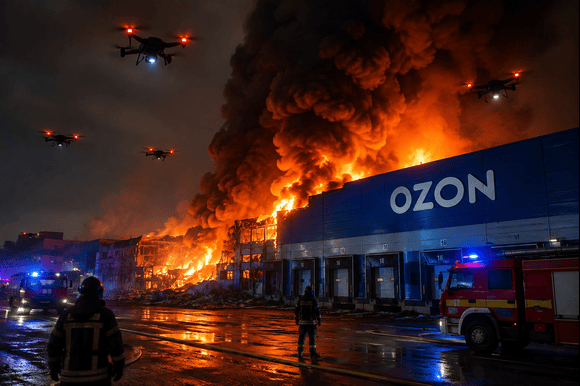
Warehouses belonging to Ozon, Russia’s second-largest online retailer, have been hit by a wave of Ukrainian drone strikes, with the company reporting fires at logistics facilities across several southern regions and multiple people injured.
Ozon said its logistics centres in Krasnodar, Dagestan, Stavropol and Adygea were affected by overnight drone attacks. The strikes caused fires at some of the facilities, while workers at other locations were evacuated as Russian authorities responded to the attacks.
The latest strikes mark an escalation in Ukraine’s campaign against major Russian logistics and online retail companies. For weeks, Ukrainian forces have targeted sites belonging to Wildberries, Russia’s largest online retailer, arguing that the company represents a legitimate military target because some goods stored and distributed through its network can be used to support Russia’s armed forces. Moscow has rejected those claims and denied that online retail platforms are being used to supply the military.
Russian President Vladimir Putin said on Saturday that Ukraine had opened what he described as a “Pandora’s box” by attacking economic targets. He warned that Moscow would retaliate by targeting what he called Kyiv’s “most sensitive economic sectors”.
Russia has repeatedly targeted Ukrainian civilian infrastructure since launching its full-scale invasion of Ukraine in February 2022. In recent months, Russian strikes have also damaged Ukrainian warehouses, cargo terminals, food storage facilities and other elements of the country’s logistics network.
Both Russia and Ukraine deny deliberately targeting civilians.
Ozon said a fire broke out at one of its logistics centres in Makhachkala, the capital of Dagestan, following a drone attack at around 05:00 local time on Monday, or 02:00 GMT.
The company had earlier reported that a “major fire” was burning at another Ozon logistics centre in Krasnodar, a major city in southern Russia located around 700km (435 miles) from Makhachkala.
Russia’s defence ministry said three children were killed in Krasnodar following a Ukrainian drone attack. Russian children’s rights commissioner Maria Lvova-Belova said the victims were aged 13, 15 and 16. Six other children were reportedly taken to hospital for treatment.
The attacks also affected Ozon facilities in other parts of southern Russia. Workers at the company’s sites in Adygeysk, in the Adygea region, and Nevinnomyssk, in the Stavropol region, were evacuated as authorities dealt with the consequences of the overnight strikes.
Videos showing the aftermath of the attacks and the fires at Ozon facilities have circulated on social media. The BBC said it had verified footage showing a drone striking a warehouse in the Orenburg region, while another video showed a huge plume of smoke and flames rising from an Ozon facility in Dagestan.
The attacks had an immediate impact on financial markets. Shares in Ozon fell by as much as 12% on the Moscow Exchange on Monday morning. Shares in AFK Sistema, the private equity firm that is a major shareholder in Ozon, also dropped by almost 13%.
The Kremlin said on Monday that the Russian government was considering ways to assist the company following the attacks. Asked whether the state would provide financial or other support to Ozon, Kremlin spokesman said authorities were “working with business representatives to develop various options for providing support in this difficult situation”.
The latest overnight strikes came just one day after another Ozon facility in Russia’s Samara region was targeted. Ozon said several of its employees were injured in that attack.
Following the Samara strike, Ukraine’s defence ministry said the attacks were aimed at weakening Russian logistics and damaging the country’s economy.
“Systematic strikes on dual-use goods storage centres complicate the enemy’s logistics and negatively affect the Russian economy as a whole,” the Ukrainian defence ministry said on Saturday. It added that after Ukrainian forces had struck 15 of Wildberries’ largest logistics hubs, “it was Ozon’s turn”.
At the same time, Ukrainian officials reported that Russian strikes had hit facilities in Ukraine’s southern Odesa region. Regional head Oleg Kiper said overnight attacks targeted food storage facilities and energy infrastructure, injuring five people.
The attacks on Ozon and Wildberries represent a significant development in the economic dimension of the Russia-Ukraine war. Both companies have become deeply embedded in everyday Russian life, operating enormous networks of warehouses, distribution centres, collection points and delivery services across the country.
Founded in 1998, Ozon is one of Russia’s earliest major online retailers. It has grown into one of the country’s largest e-commerce platforms and is second only to Wildberries in terms of scale and market presence.
Ozon operates delivery networks and collection points throughout Russia, including in remote areas where access to conventional shops can be limited. Its distinctive delivery boxes and collection points are widely visible across Russian cities and towns.
Wildberries and Ozon are also frequently seen operating alongside each other, with the two companies sharing or maintaining collection points in some locations.
Both companies have often been compared with Amazon and are sometimes described as “Russia’s Amazon”. Estimates suggest that around 85% to 90% of Russia’s economically active population uses one or both platforms, highlighting how deeply the companies have become integrated into ordinary consumers’ lives.
For people living in remote areas, the platforms can be particularly important because they provide access to clothing, household appliances and other everyday goods that may not be readily available in local shops.
However, the comparison with Amazon has important limitations. While Amazon sells products directly as well as operating a marketplace for independent sellers, Ozon and Wildberries operate largely as marketplace platforms.
They connect independent sellers with consumers, while also providing warehousing, delivery, payment processing and other logistical services. As a result, damage to their warehouses and distribution infrastructure can affect thousands of businesses and sellers whose goods are stored within the facilities.
This means that the financial consequences of the Ukrainian attacks are not necessarily limited to the retailers themselves. Independent businesses using Ozon and Wildberries to store and distribute their products can also suffer significant losses when warehouses are damaged or destroyed.
The attacks have also brought the war closer to ordinary Russian consumers. For many Russians, online shopping platforms are among the most visible parts of the country’s modern economy, and strikes against their warehouses can directly disrupt the delivery of everyday products.
Ukraine has increasingly targeted Russian logistics infrastructure as part of its wider campaign to disrupt military supply chains and weaken Russia’s ability to sustain its war effort. Kyiv argues that facilities storing or transporting dual-use goods can contribute to Russia’s military capabilities.
The Kremlin, however, has denied that online retail platforms such as Ozon and Wildberries are being used to supply the Russian military.
The latest strikes are likely to increase pressure on Moscow to protect major commercial and logistics facilities from Ukrainian drone attacks. They also raise concerns for businesses and consumers whose operations depend on the country’s extensive e-commerce distribution network.
As the conflict continues, attacks on economic and logistical infrastructure are becoming an increasingly important part of the confrontation between Russia and Ukraine, with both sides seeking to disrupt the other’s supply chains while denying that they deliberately target civilians.