

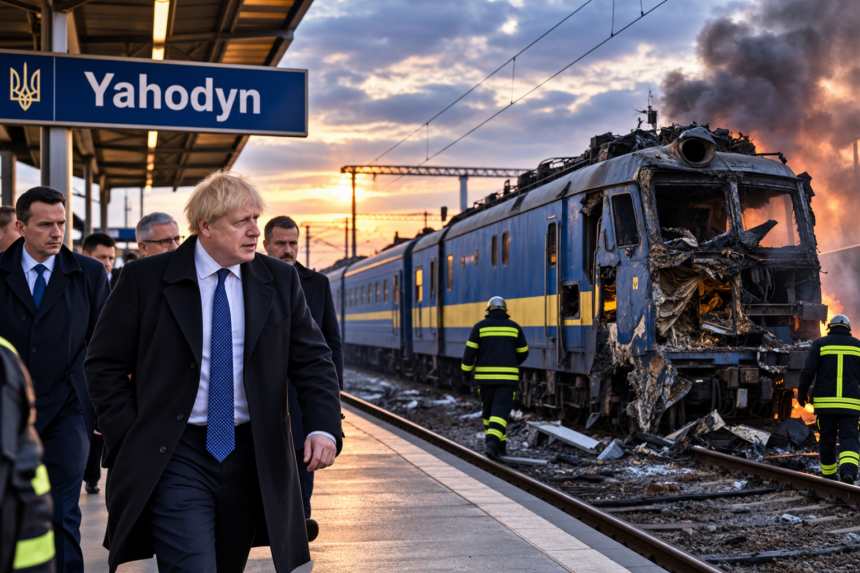
A Russian drone struck a Ukrainian train near the country’s border with Poland, shortly after former British Prime Minister Boris Johnson and senior European security officials had travelled through the same railway area.
The strike took place at Yahodyn, a railway location in western Ukraine situated about 2km (1.2 miles) from the Polish border. Ukrainian authorities said the drone hit the train’s engine, while passengers were evacuated and no casualties were reported.
Johnson and several European national security officials, including UK National Security Adviser Jonathan Powell, had travelled along the railway line on a separate train while returning from a conference in Kyiv.
Drone strikes train near Polish border
Russia said its forces had targeted railway infrastructure in western Ukraine. Ukraine’s state railway operator, Ukrzaliznytsia, however, raised the possibility that the diplomatic train travelling through the area could have been the intended target.
The railway company said the diplomatic train had departed earlier than scheduled after its timetable was changed because of continuing concerns about Russian attacks.
Ukrzaliznytsia also said passengers on the train that was eventually hit received an evacuation warning roughly 15 minutes before the strike. The company described the weapon as a Russian jet-powered drone.
The location of the attack has attracted particular attention because of its proximity to Poland, a NATO and European Union member.
European officials were travelling from Kyiv
Johnson and other senior European security figures had been attending the Yalta European Strategy conference in Kyiv.
The annual event brings together political leaders, security specialists, business representatives and media figures to discuss major international and regional issues.
After the conference, the officials began travelling west towards Poland. Their train passed through the railway area before the drone attack occurred.
The timing has led to questions about whether the attack was connected to the movement of the diplomatic delegation. Ukrainian railway officials have not established that conclusively.
David Petraeus describes the incident
Former CIA director David Petraeus was aboard another train at Yahodyn station when the strike happened.
Petraeus later described the experience as frightening and strongly condemned the attack. Speaking to The New York Times, he accused Russia’s leadership of using violence to intimidate Ukrainian civilians.
His comments added to international criticism of the attack, particularly because the strike occurred close to a route being used by European officials and civilian passengers.
Carl Bildt recalls evacuation warning
Former Swedish Prime Minister Carl Bildt, who had also attended the Kyiv conference, was travelling by train in the region.
Bildt said passengers on his train were instructed to prepare for evacuation after the train stopped. They were later informed that it was safe to continue travelling.
His train subsequently reached Dorohusk, Poland’s border station, safely.
There have been reports suggesting Bildt may have been travelling on the same train as Johnson, although the former British prime minister has not publicly confirmed those reports.
Johnson calls for more air defence
Johnson later criticised the attack and questioned the reasoning behind striking a stationary Ukrainian locomotive near the Polish border.
He said the incident reflected the wider danger faced by Ukrainian civilians and called on countries supporting Ukraine to provide additional air-defence capabilities.
Ukraine has repeatedly appealed to its Western allies, including the United States, for more interceptors and other defensive equipment.
Kyiv says the need for additional air defence has become increasingly urgent as Russia continues to employ drones and missiles, including fast-moving ballistic weapons and jet-powered drones.
Ukraine calls for stronger sanctions
Ukrainian Foreign Minister Andrii Sybiha condemned the strike and warned that Russian military activity was moving increasingly close to the borders of the European Union and NATO.
Sybiha renewed Ukraine’s call for tougher sanctions against Moscow. He argued that Russia should face increased economic and political pressure over its continuing attacks.
The Ukrainian government has repeatedly urged its allies to combine military assistance with additional measures designed to increase the cost of Russia’s war.
Poland holds emergency meeting
The incident also prompted an immediate response in Poland.
Prime Minister Donald Tusk convened an emergency meeting to discuss the developments. He warned that the escalation of Russian activity was becoming increasingly serious and that Russian attacks were occurring closer to Poland’s border.
Although the reported strike occurred inside Ukraine, its location has increased concern among neighbouring NATO countries about the potential consequences of attacks close to their territory.
Railway security remains a major concern
Ukraine’s railway network continues to play an important role in keeping civilian and international transport operating during the war. Railway routes are also frequently used by foreign officials and international delegations travelling between Ukraine and neighbouring European countries.
The Yahodyn incident demonstrates the risks facing those routes as Russian attacks continue to target Ukrainian infrastructure.
For European governments, the episode is also significant because it occurred close to the Polish border and shortly after senior European officials had passed through the area.
No casualties were reported in the incident, but the attack has renewed questions about the protection of Ukraine’s railway infrastructure and the need for stronger air-defence systems.