

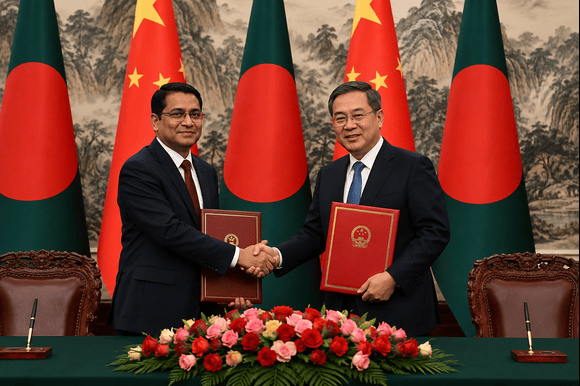
Beijing, June 26: Bangladesh and China have announced a significant expansion of their bilateral relationship, unveiling a comprehensive joint communiqué that outlines an upgraded strategic partnership and a wide-ranging roadmap for cooperation across trade, infrastructure, defence, connectivity, investment and regional affairs.
The joint statement was released in Beijing following the official visit of Bangladesh Prime Minister Tarique Rahman, who travelled to China from June 22 to 26 at the invitation of Chinese Premier Li Qiang. During the visit, Rahman also participated in the 17th Annual Meeting of the New Champions 2026, commonly known as the Summer Davos Forum, held in Dalian.
The visit featured high-level meetings between Prime Minister Rahman and Chinese President Xi Jinping, Premier Li Qiang, and Zhao Leji, Chairman of the Standing Committee of the National People’s Congress. Leaders from both countries held extensive discussions on bilateral ties as well as regional and global issues of mutual concern, ultimately reaching broad consensus on strengthening cooperation.
A central outcome of the visit was the decision to elevate the existing comprehensive strategic cooperative partnership into what both governments described as a “China-Bangladesh community with a shared future in the new era.” The two sides said the upgraded relationship is intended to generate greater benefits for both nations while expanding collaboration in multiple sectors.
China congratulated Bangladesh on successfully conducting its February 2026 general election and expressed support for the policies of the new government, particularly its “Bangladesh Before All” development agenda. Bangladesh, in turn, welcomed China’s 15th Five-Year Plan, saying it would create fresh opportunities for bilateral economic and development cooperation.
To strengthen political engagement, both countries agreed to maintain regular high-level exchanges and enhance cooperation between governments, legislative institutions and political parties. They also agreed to establish a new strategic dialogue mechanism between their foreign ministers while exploring the creation of a “2+2” dialogue involving officials responsible for diplomacy and defence.
The joint communiqué reaffirmed both countries’ commitment to supporting each other’s core national interests. Bangladesh reiterated its firm adherence to the one-China policy, recognizing the People’s Republic of China as the sole legitimate government representing China and reaffirming that Taiwan is an inseparable part of Chinese territory. Dhaka also expressed opposition to any form of Taiwan independence and voiced support for China’s efforts toward national reunification.
China reaffirmed its longstanding support for Bangladesh’s sovereignty, territorial integrity and independent path of development, emphasizing its policy of maintaining friendly relations with the people of Bangladesh.
Economic cooperation featured prominently in the agreements reached during the visit. Both sides pledged to accelerate high-quality cooperation under China’s Belt and Road Initiative, with an emphasis on supporting Bangladesh’s industrialization, agricultural modernization and broader economic transformation.
China committed to strengthening collaboration with Bangladesh in trade, e-commerce, industrial supply chains and investment while supporting efforts to expand Bangladesh’s export capacity and safeguard the multilateral trading system. Bangladesh welcomed China’s decision to provide zero-tariff treatment for 100 percent of Bangladeshi tariff lines and pledged to create a more favorable investment climate for Chinese companies operating in the country.
The two governments also agreed to move forward with several major infrastructure projects, including the modernization and expansion of Mongla Port and continued development of the Chinese Economic and Industrial Zone in Chattogram.
Connectivity and technological cooperation also formed an important pillar of the expanded partnership. Both countries agreed to deepen collaboration in transportation connectivity, scientific research, technological innovation, telecommunications, renewable energy, photovoltaic technology, disaster management and climate change adaptation.
The communiqué also highlighted plans to explore new regional connectivity initiatives, including the possibility of establishing direct connectivity between China and Bangladesh.
Water resource management emerged as another key area of cooperation. Both governments agreed to work together on integrated water management, hydrological forecasting, flood control, river dredging and related technological exchanges.
China pledged to provide support, within its capacity, for the Teesta River Comprehensive Management and Restoration Project (TRCMRP). Both sides agreed to expedite feasibility studies and other preparatory work necessary to advance the long-discussed project. They also committed to expanding cooperation in maritime affairs.
Defence cooperation is set to expand through increased military exchanges, official visits and training programmes. The two countries further agreed to continue consultations and coordination regarding participation in United Nations peacekeeping operations.
The communiqué also emphasized strengthening people-to-people exchanges following the successful celebration of the 50th anniversary of diplomatic relations and the Year of China-Bangladesh People-to-People Exchanges in 2025.
Both governments agreed to broaden cooperation in media, think tanks, education, film production, publishing, youth exchanges, sports and cultural activities. China reaffirmed its commitment to providing educational opportunities for Bangladeshi students while both countries pledged to strengthen partnerships between universities and vocational institutions.
The two sides also agreed to enhance cooperation in public health, traditional medicine and human resource development. Bangladesh welcomed the contributions of Chinese provincial authorities, particularly Yunnan Province, in expanding healthcare cooperation.
On multilateral issues, Bangladesh expressed support for China’s vision of building a community with a shared future for humanity as well as several global initiatives proposed by President Xi Jinping. China, in return, backed Bangladesh’s efforts to play a more active role in international organizations.
Notably, Beijing voiced support for Bangladesh’s aspiration to participate in BRICS and endorsed Dhaka’s application to become a partner of the Shanghai Cooperation Organisation (SCO). Both countries also expressed their willingness to strengthen regional multilateral cooperation and welcomed the participation of additional countries in future initiatives.
The two governments reaffirmed their commitment to safeguarding the United Nations-centered international system, promoting international law and defending the principles of the UN Charter. They also pledged to support an equitable multipolar global order and a more inclusive model of economic globalization.
Additionally, both sides stressed the importance of preserving the outcomes of World War II, opposing any revival of fascism or militarism, and upholding the post-war international order established under the Cairo Declaration, the Potsdam Proclamation and other international legal instruments.
The joint communiqué also addressed the ongoing Rohingya refugee crisis. Bangladesh acknowledged China’s constructive efforts in facilitating discussions on the return of displaced people from Myanmar’s Rakhine State, while China praised Bangladesh for continuing to provide humanitarian assistance to the refugees.
Beijing reaffirmed its support for continued dialogue between Bangladesh and Myanmar aimed at achieving a mutually acceptable solution and pledged to continue facilitating the repatriation process to the best of its capabilities.
During the visit, Bangladesh and China signed multiple agreements and cooperation documents covering development assistance, human resource development, agriculture, education, trade, investment and media collaboration.
Prime Minister Tarique Rahman concluded his visit by expressing appreciation to the Chinese government and people for the warm hospitality extended to him and his delegation. He also invited China’s leadership to pay an official visit to Bangladesh at a mutually convenient time, underscoring both countries’ commitment to sustaining the momentum of their expanding strategic partnership.