


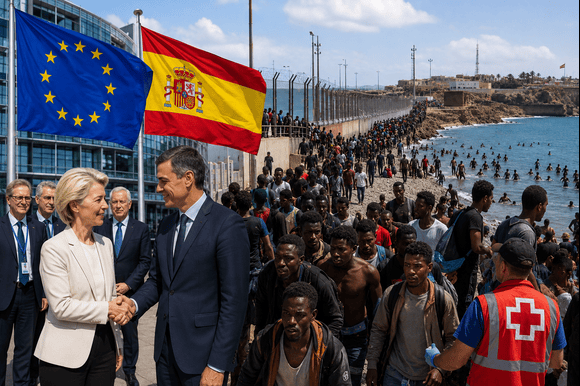
The European Union has commended Spain for its “swift response” to the major migrant crisis in Ceuta following an emergency meeting of the bloc’s interior ministers on Tuesday.
Spain’s Interior Minister Fernando Grande-Marlaska said approximately 72,000 migrants crossed into the Spanish territory in North Africa between 30 and 31 July. He added that around 70,000 people had since been returned to Morocco as Spanish authorities worked to regain control of the situation.
The large-scale movement of migrants resulted in a significant humanitarian crisis, with at least 75 people reported dead on the Spanish side of the border. Moroccan authorities also reported 11 deaths.
The emergency meeting of EU interior ministers was arranged after several member states raised concerns about Spain’s handling of the unprecedented influx. Italy described images emerging from Ceuta as “shocking” and announced that it was suspending its Schengen agreement with Spain.
Irish Justice Minister Jim O’Callaghan, who chaired Tuesday’s meeting, said the European Union stood alongside Spain and stressed that migration was an issue requiring “a united European response”.
The meeting was expected to involve difficult discussions following criticism directed at Spain by several European governments in the days leading up to the gathering.
On Thursday, Italy’s right-wing Prime Minister Giorgia Meloni described the large-scale arrivals as “uncontrolled immigration” and warned that the situation posed a potential security threat to Europe.
Italy suspended its Schengen free-movement arrangement with Spain on Friday. Since Italy and Spain do not share a land border, the measure would mainly affect air travel and appears to involve additional checks for passengers travelling between the two countries.
Finland and Denmark supported Italy’s decision, while Czech Prime Minister Andrej Babiš called for Spain’s membership of the Schengen zone to be temporarily suspended.
Italy, Denmark and 20 other European countries later sent a joint letter expressing concern about the scale of the migrant crisis in Ceuta and the possible impact on European border security.
Spanish Prime Minister Pedro Sánchez responded by saying he had “serious concerns” about the actions and statements made by certain European governments. He also pointed out that Ceuta is not included within the Schengen area.
Sánchez said that while the majority of EU governments had demonstrated “support and solidarity” with Spain, others had chosen to criticise and attack the country.
He accused some European governments of being motivated by “prejudice, fake news, ignorance, or political interest” rather than focusing on cooperation and a coordinated response to the crisis.
Speaking after Tuesday’s meeting, Grande-Marlaska said the Schengen zone had not been affected or compromised by the events in Ceuta. He added that he hoped Italy would remove its additional travel controls “as soon as possible”.
Denmark’s Immigration Minister Morten Bødskov said he was “very satisfied” with the speed of Spain’s response to the crisis. However, he said the incident had demonstrated that maintaining effective control of the European Union’s external borders was essential.
“it is absolutely crucial that we have control over the EU’s borders,” Bødskov said.
European Commissioner Magnus Brunner described the crisis as a major “test” of Europe’s ability to protect its borders and respond to large-scale migration.
He said the European Union had successfully “passed” the test and added that the bloc had offered Spain emergency financial assistance to reinforce border security and support efforts to manage the humanitarian situation.
The precise reasons why tens of thousands of migrants crossed from Morocco into Ceuta within only a few hours last week remain unclear.
Brunner said initial assessments suggested that criminal networks and misinformation spread through social media may have contributed to the sudden and unprecedented movement of people towards the Spanish territory.
The large-scale crossings occurred shortly after Spain’s Supreme Court issued a ruling concerning migrants attempting to reach Ceuta and Melilla, another Spanish territory located in North Africa.
The court ruled that migrants intercepted at sea while attempting to reach either Ceuta or Melilla could not be immediately and summarily returned to Morocco.
Moroccan authorities later said they had warned Spain that the court ruling could create “a problem” and potentially encourage increased migration towards the Spanish territories.
Spain rejected the claim. A Spanish government spokeswoman said authorities had received no evidence or intelligence indicating that such a large and unprecedented migration event was likely to occur.
Grande-Marlaska said Spain was continuing to work “firmly” with Moroccan authorities to prevent further “violations” of Spain’s borders.
He added that migrants who remained in Ceuta would be returned to Morocco as quickly as possible under arrangements being discussed between the two countries.
Images from Ceuta on Tuesday showed large groups of migrants gathering close to the beach as humanitarian organisations and local authorities distributed food, drinking water and other emergency supplies.
Some migrants were seen holding improvised banners carrying the word “asylum”, highlighting their requests for international protection and the uncertainty surrounding their future.
Other images showed people sleeping along the beach and on streets throughout the city as authorities continued efforts to provide accommodation and essential support.
Concerns have also been raised regarding the treatment and welfare of migrants who remain in Ceuta, particularly unaccompanied children.
Local media reported that approximately 800 minors were being housed in facilities across the city, increasing pressure on local services and raising questions about whether existing accommodation could meet their needs.
Ahmed Haroun, a 29-year-old migrant from Sudan, said reaching Ceuta had been his “dream” for many years.
Speaking to the Reuters news agency, Haroun said members of his family were waiting for him and that he hoped to support them financially.
“I want to help them,” he said.
Haroun said conditions had improved during the previous few days and that he was now receiving humanitarian assistance and support.
However, he said he remained uncertain about whether Spanish authorities would allow him to remain in the territory or return him to Morocco.
Djibril, a migrant from Senegal, criticised the Spanish government’s response and insisted that the people who had arrived in Ceuta had not crossed the border with the intention of causing problems.
“We’re not thieves,” he told Spanish broadcaster RTVE.
He said the lack of a clear response and the conditions faced by migrants were inhumane.
“For five days you’ve left people on your territory,” he said. “They’re not eating, they’re not showering, they’re ill.”
Another migrant, Kamal, a 24-year-old from Sudan, said he had been “forced” to remain in Morocco and was searching for a country where he could receive protection.
“Now it’s very difficult and it’s getting more difficult,” he told Reuters.
Kamal said many migrants were struggling without access to basic necessities.
“No food, nowhere to sleep, not even blankets to warm up from the cold. We live in front of the beach,” he said.
Spain’s interior minister said the government was protecting the rights of all migrants affected by the crisis, with particular attention being given to children and other vulnerable people.
Grande-Marlaska said Spain was ensuring that the rights of underage migrants were respected while authorities continued to manage the large-scale humanitarian and border emergency.
The Spanish government has allocated approximately €25 million (£21.4 million; $28.8 million) to support unaccompanied minors and other children affected by the crisis in Ceuta.
The funding is expected to help local authorities expand accommodation, provide food and medical assistance, and improve support services for children who remain in the territory.
Although the European Union praised Spain’s rapid response and offered emergency assistance, the crisis has exposed deep divisions among member states over migration policy, border security and the future of the Schengen free-movement system.
The events in Ceuta have also highlighted the wider humanitarian challenges facing migrants seeking protection in Europe and the pressure placed on countries located along the EU’s external borders.
European leaders are expected to continue discussions on how to strengthen border controls while ensuring that the rights and welfare of migrants, particularly unaccompanied children, are protected.
I can also create SEO-optimized headlines for this story.