

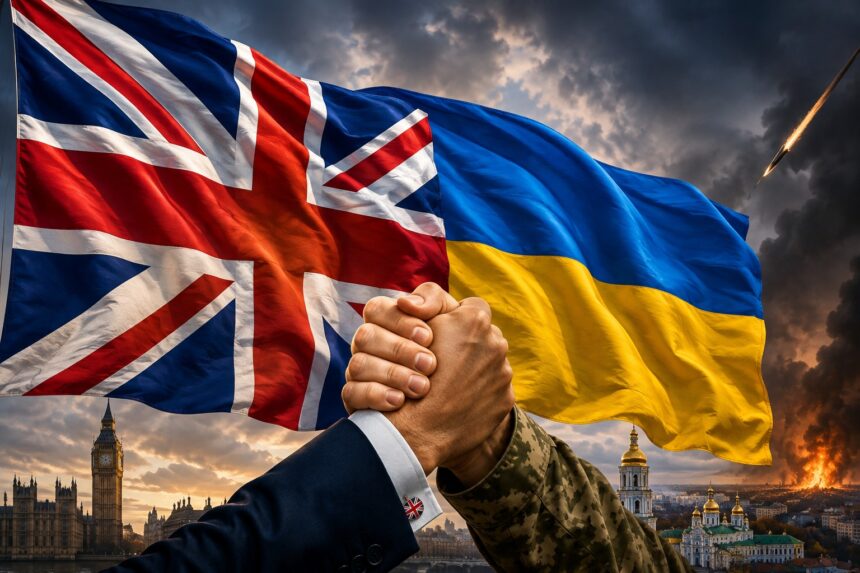
UK Prime Minister Andy Burnham has reaffirmed Britain’s commitment to Ukraine, saying the country will continue receiving British support despite what he described as “outrageous threats” from Russia.
Burnham made the comments during a visit to Kyiv on Ukraine’s Independence Day, using his trip to underline Britain’s continued backing for the Ukrainian government as the war with Russia enters another prolonged phase.
Standing outside Kyiv’s historic St Sophia Cathedral, Burnham praised the Ukrainian people for their resistance and determination to defend their country. He drew parallels between Ukraine’s current struggle and Britain’s role in defending European freedom during the Second World War.
Burnham said Britain had once helped keep the cause of European freedom alive and argued that Ukrainians are now carrying that responsibility in the 21st century.
He insisted that Russian warnings would not persuade Britain to reduce its assistance to Kyiv.
Britain Stands Firm Despite Russian Warnings
Burnham’s comments followed strong criticism from Moscow over Britain’s growing military cooperation with Ukraine.
Russia has objected particularly strongly to Britain sharing technical information with Ukraine related to components used in long-range Storm Shadow cruise missiles. The move is intended to help Ukraine increase its own production capabilities and become less dependent on weapons supplied directly by Western countries.
British and French governments have also been working with Ukraine on plans to strengthen the country’s domestic defence industry, including the potential production and assembly of long-range weapons inside Ukraine.
Moscow has warned that such developments could further escalate the conflict and has accused Britain of becoming increasingly involved in the war.
Russian officials have argued that Ukrainian facilities involved in producing long-range weapons could become targets for Russian attacks.
Burnham, however, dismissed the criticism and questioned Moscow’s description of Britain’s actions as an escalation.
He pointed out that Russia was responsible for launching the war and maintained that Ukraine and its allies were responding to Russian aggression rather than creating the conflict.
Ukraine Described as Europe’s Frontline Defender
During his visit, Burnham portrayed Ukraine as an important part of Europe’s wider security system.
He argued that Ukraine should not be viewed as placing a burden on European countries but rather as helping protect the continent by resisting Russian military aggression.
According to Burnham, Ukraine has effectively become the frontline of European security, preventing the conflict from spreading further across the continent.
He also stressed Britain’s continued commitment to Ukraine’s sovereignty and territorial integrity, maintaining that national borders cannot legitimately be changed through military force.
The British leader told Ukrainians that the UK would remain alongside them throughout the conflict and would not withdraw its support when circumstances become difficult.
Calls for Stronger Military Assistance
Burnham’s visit also highlighted Ukraine’s continuing need for military assistance, particularly air-defence equipment.
Ukraine has repeatedly appealed to its Western partners for additional systems capable of intercepting Russian missiles and drones. Kyiv says strengthening its air defences is essential to protecting civilians, cities and critical infrastructure from continuing Russian attacks.
Burnham called on Britain and its international partners to consider how existing military resources could be used more effectively to support Ukraine.
The issue is expected to remain central to discussions among European countries supporting Kyiv, particularly as allies consider longer-term security guarantees for Ukraine.
Tensions Between London and Moscow
Relations between Britain and Russia have deteriorated significantly since the full-scale invasion of Ukraine.
Moscow has repeatedly criticised London for supplying weapons, sharing military expertise and supporting Ukraine’s efforts to develop its own defence capabilities.
Russian officials have warned that Britain could face consequences for becoming more deeply involved in supporting Kyiv.
Britain, meanwhile, maintains that Ukraine has a legitimate right to defend itself and that Western assistance is necessary to help the country resist Russian aggression.
The latest dispute over long-range missile technology is another indication of how far relations between the two countries have deteriorated.
Despite the warnings from Moscow, Burnham has made clear that Britain does not intend to change course.
Independence Day Becomes a Show of Resistance
Burnham’s visit coincided with Ukraine’s Independence Day, an occasion that carried particular significance during the ongoing war.
Ukraine declared independence from the Soviet Union in 1991, and this year’s anniversary was marked against the backdrop of continuing Russian attacks and uncertainty over the prospects for a lasting peace agreement.
President Volodymyr Zelenskyy has repeatedly said that Ukraine wants an end to the war but will not accept a settlement that undermines the country’s sovereignty or leaves it vulnerable to future Russian aggression.
European leaders have similarly stressed the importance of ensuring Ukraine has sufficient security guarantees if a peace agreement is eventually reached.
For Kyiv, the presence of a senior British leader during the anniversary celebrations served as an important demonstration of international solidarity.
Britain Signals Long-Term Commitment
Burnham’s visit also offered an indication of how Britain intends to approach Ukraine policy in the longer term.
Rather than limiting assistance to immediate military supplies, Britain is increasingly supporting efforts to strengthen Ukraine’s own defence industry and production capabilities.
This approach could give Kyiv greater capacity to manufacture weapons domestically while reducing reliance on deliveries from Western allies.
For Burnham, the visit also provided an opportunity to demonstrate that Ukraine remains a major priority in Britain’s foreign and security policy.
His remarks indicate that London is prepared to maintain its support even as Russia increases its warnings against Western involvement.
The message from the British prime minister was direct: Russian threats will not force the UK to abandon Ukraine.
As the war continues, Britain appears determined to remain closely involved in efforts to strengthen Ukraine’s military capabilities and support its sovereignty, while working with European allies on the country’s long-term security.
Burnham’s declaration in Kyiv therefore represents more than a statement of political solidarity. It is also a clear signal to Moscow that Britain intends to remain firmly on Ukraine’s side despite the growing risks and diplomatic tensions surrounding the conflict.