


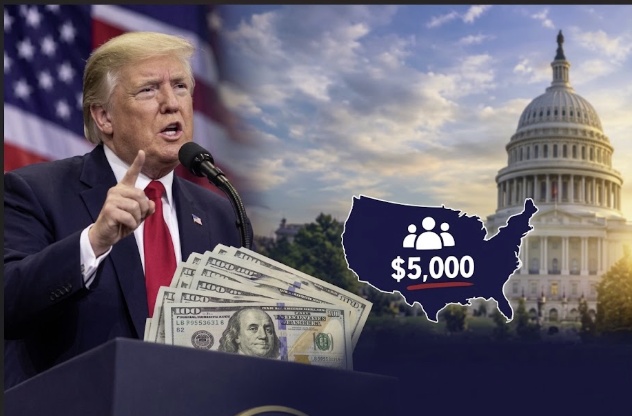
Donald Trump says Americans could receive a $5,000 payment if Republicans secure control of both the House and Senate in the November midterm elections, a proposal that could cost the federal government more than $1 trillion.
US President Donald Trump has proposed what he called a “dividend” for American adults if Republicans win control of both chambers of Congress in the upcoming midterm elections.
Speaking at the Republican Party’s first convention held during a presidential term, Trump said he would provide a $5,000 payment to every adult citizen if Republicans capture both the House of Representatives and the Senate.
The president did not provide a detailed explanation of how the payments would be financed or whether Congress would first need to approve the spending. He said, however, that recipients would be expected to spend the money within the United States rather than taking it overseas.
“We don’t want you going to Canada to spend the money,” Trump said, adding that the funds should be spent in the United States.
The proposal would represent a substantial financial commitment. With nearly 270 million adults in the country, payments of $5,000 per person could amount to roughly $1.3 trillion.
The announcement immediately drew criticism from Democrats, who described the proposal as an unrealistic promise. Questions have also emerged over the legal and constitutional issues surrounding a payment linked directly to an election outcome.
Under the US system, Congress has authority over federal spending, and Trump did not make clear during his speech whether he would seek congressional approval for the proposed payments.
Trump has previously floated similar ideas. In an earlier proposal, he suggested $2,000 payments that would be financed through revenue generated by tariffs.
The latest announcement comes as the administration faces economic pressure connected to the ongoing conflict involving the United States, Israel and Iran. Rising energy prices and uncertainty surrounding the Strait of Hormuz have added to concerns about the cost of living.
Iran’s retaliation has included attacks targeting US bases and allies in the Gulf, while disruption around the Strait of Hormuz has affected a major international energy route. Around one-fifth of the world’s oil and liquefied natural gas traditionally passes through the waterway.
The resulting uncertainty has contributed to volatility in global oil markets and increased pressure on Trump to bring the conflict to an end.
Trump has warned supporters that the conflict could continue beyond the midterm elections and that oil prices may remain elevated until then. During his appearance in Dallas, he argued that accepting short-term economic difficulties was necessary to prevent Iran from developing nuclear weapons.
The proposed $5,000 payment became one of the most enthusiastically received parts of his economic message at the Republican gathering, as Trump presented it as a way of increasing Americans’ spending power.
However, major questions remain unanswered, including how the government would finance the program, who would qualify, how payments would be administered and whether restrictions requiring Americans to spend the money domestically could actually be enforced.
The proposal could also face legal scrutiny. Federal election laws restrict certain payments or benefits intended to influence voting behavior. Some legal experts, however, have suggested that Trump’s proposal could instead be interpreted as a tax-related measure, while others have pointed to First Amendment protections surrounding political speech.
For now, the proposal remains a political pledge rather than an established federal payment program, with its potential cost, legal basis and implementation still unclear.